Word Art: The Flow of Change

I’m not sure which rabbit hole of links I tumbled down to land on the virtual doorstep of Pace and Kyeli, but I can certainly say that I’m glad I did.  It was refreshing to see such enthusiasm, optimism, sensitivity and encouragement in the cynical wilds of the blogosphere.  I added their blog to my RSS feeds, looked forward to each new chapter of The Usual Error and signed up for the Freak Revolution (which is now the Connection Revolution.)

When they announced a scholarship contest for their upcoming World Changing Writing Workshop, I decided this would be an excellent motivator to finish a Word Art piece I’d started but had gotten stalled on, which was also on the topic of change.  Even if I didn’t win, I’ve have some art to show for it.  As it progressed, I was less and less happy with how it was coming together visually, so I scrapped the initial design and carried the words over to a revised piece, with a better shape and a more harmonious color scheme.
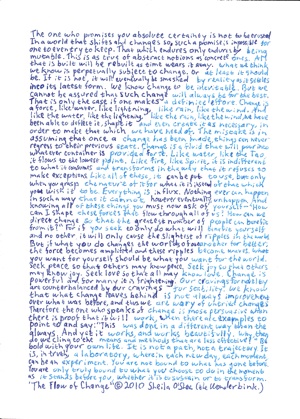
The Flow of Change

The Flow of Change

The one who promises you absolute certainty is not to be trusted.

In a world that shifts and changes so, such a promise is impossible for one to even try to keep.

That which endures only endures by being mutable.

This is as true of abstract notions as concrete ones.

All that is built will be rebuilt as time wears it away.

What we think we know is perpetually subject to change.

Or at least it should be.

If it is not, it will eventually be smashed by reality as it settles into its latest form.

We know change to be inevitable.

But we cannot be assured that such change will always be for the best.

That is only the case if one makes a definite effort.

Change is a force, like water, like lightning, like rain, like the wind.

And like the water, like the lightning, like the rain, like the wind, we have been able to deflect it, shape it and even create it as necessary, in order to make that which we have need of.

The mistake is in assuming that once a change has been made, things can never regress to their previous state.

Change is a fluid that will pour into whatever container is provided for it.

Like water, like the Tao, it flows to the lowest point.

Like fire, like Spirit, it is indifferent to what it consumes and transforms in the way that it refuses to make exceptions.

Like all of these, it can be put to use, but only when you grasp the nature of it for what it is instead of what which you wish it to be.

Everything is in flux.

Nothing can ever happen in such a way that it cannot, however eventually, unhappen.

And knowing all of these things, you must now ask of yourself–”How can I shape these forces that flow through all of us? How can we direct change so that the greatest number of people can benefit from it?”

For if you seek to only do what will benefit yourself and no other, it will only cause the slightest of ripples in the world.

But if what you do changes the worlds of one another for better, the force becomes amplified and these ripples become waves.

What you want for yourself should be what you want for the world.

Seek peace so that others may know peace.

Seek joy so that others may know joy.

Seek love so that all may know love.

Change is powerful and for many it is frightening.

Our cravings for novelty are counterbalanced by our cravings for stability.

We know that what change leaves behind is not always improvement over what was before, and thus we are wary of untried changes.

Therefore the one who speaks of change is most persuasive when there is proof that it will work, when there are examples to point to and say: “This was done in a different way than the always. And yet it works, and works beautifully. Why, then, do we cling to the means and methods that are less effective?”

Be bold with your own life.

It is not a path, not a trajectory.

It is, in truth, a laboratory, wherein each new day, each moment, can be an experiment.

You are not bound to what has gone before.

You are only truly bound to what you choose to do in the moment as it stands before you, whether it is to sustain or to transform.

About halfway through making this piece, I came to a decision about it, but I kept that decision to myself until after the winners of the contest had been announced.  Once the winners were announced (I placed as a runner-up, which was an honor in itself) I asked Kyeli for a mailing address, so I could present the original to her and Pace as a belated wedding present.

I’ve been told it now hangs behind Pace’s desk for inspiration, which is kind of fun to think about–that I am able to inspire those who have in turn inspired me.

Printout of this work (10 MB .jpg file) available here.  Please read the license details.

The original has been given to Pace and Kyeli Smith.
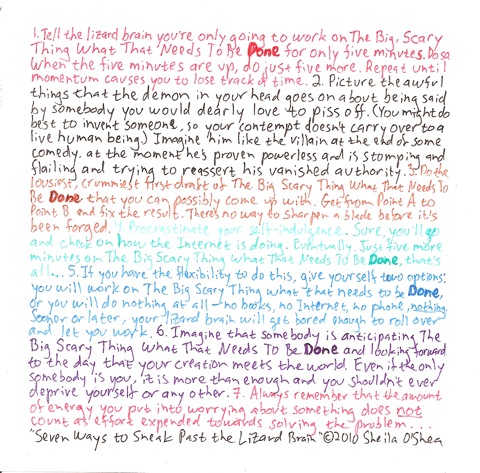
Word Art: Seven Ways to Sneak Past the Lizard Brain

Whenever possible, I set aside my birthday as a day to go out, explore, ramble and indulge myself a bit.  June 14, 2010 was no exception.  I spent the day visiting Centennial Olympic Park and the Georgia Aquarium and that evening I went to a restaurant in Virginia Highlands for Linchpin day.

Linchpin day was, in short, a gathering of folks inspired by the Seth Godin book Linchpin: Are You Indispensible?, which I hadn’t even read yet but was looking forward to doing so.  I had a marvelous time meeting with people who were enthusiastic about the idea that work could be about passion, about connection, about making a difference in the world and that your job didn’t have to be some horrible hellish thing you put yourself through so you can pay for a secure place to sleep and watch television in.

While gathering information about the meetup, I also found out that a group of people were putting together a magazine to commemorate Linchpin day and to make sure that contributors would ‘ship’ as quickly as possible, they placed a 48-hour deadline just after the meetings, so people would get their ideas and impressions in right away instead of dithering.

So the next day, I bought a copy of Linchpin, read the whole thing, got out my materials and made some art.

Seven Ways to Sneak Past the Lizard Brain

1.  Tell the lizard brain you’re only going to work on The Big, Scary Thing What That Needs To Be Done for only five minutes.  Do so.  When the five minutes are up, do just five more.  Repeat until momentum causes you to lose track of time.

2.  Picture the awful things that the demon in your head goes on about being said by somebody you would dearly love to piss off.  (You might do best to invent someone, so your contempt doesn’t carry over to a live human being.)  Imagine him like the villain at the end of some comedy, at the moment he has been proven powerless and is stomping and flailing and trying to reassert his vanished authority.

3.  Do the lousiest, crummiest first draft of The Big Scary Thing What That Needs To Be Done that you can possibly come up with.  Get from Point A to Point B and fix the result.  There’s no way to sharpen a blade before it’s been forged.

4.  Procrastinate your self-indulgence.  Sure, you’ll go and check on how the Internet is doing.  Eventually.  Just five more minutes on The Big Scary Thing What That Needs To Be Done, that’s all . . .

5.  If you have the flexibility to do this, give yourself two options: you will work on The Big Scary Thing What That Needs To Be Done, or you will do nothing at all–no books, no Internet, no phone, nothing.  Sooner or later, your lizard brain will get bored enough to roll over and let you work.

6.  Imagine that somebody is anticipating The Big Scary Thing What That Needs To Be Done and looking forward to the day that your creation meets the world.  Even if the only somebody is you, it is more than enough and you shouldn’t ever deprive yourself or any other.

7.  Always remember that the amount of energy you put into worrying about something does not count as effort expended towards solving the problem . . .

(For those of you scratching your heads and wondering what a ‘lizard brain’ is, I’ll just quote a bit from the book itself to explain:  “The lizard brain only wants to eat and be safe . . . The lizard brain cares what everyone else thinks, because status in the tribe is essential to its survival . . . The lizard brain is the reason you’re afraid, the reason you don’t do all the art you can, the reason you don’t ship when you can.”)

The reason the word “Done” is in bold?  Because I screwed it up the first time I wrote it and correcting it resulted in it resembling boldface.  So I kept it for all subsequent iterations.  This was very much a making-it-up-as-I-went-along kind of work, which meant I reached into my handy bag of Stuff I Say To Myself An Awful Lot (particularly the last line) in order to get the page filled.  But it seemed like the kind of advice that others might benefit from, so there you are.

I sent it in to the magazine and wasn’t sure if they’d even make use of it, or if it would just wind up on the website edition, but much to my amazement when I got my copy, there I was on page 33.  Then I looked in the back and saw that my website was there on the contributors list and thought, hmm, I should probably update or something . . .

Printout of this work (3.1 MB .jpg file) available here.  Please read the license details.

The original is not for sale.

Word Art: How to Kill Demons

When I’d finished up Exile and The Intruders had finished their set, I packed up and said goodnight to the lads and showed them my work in a kind of “look what I did while you were playing!” way.  I didn’t expect any of them would even attempt to read it.  One of the guitarists did, however.  Or, rather, he asked me to read part of it to him.  I think I read him the last couple of lines, blushed a bit at being exposed like that, and gave him one of my hand-written bizniz cards so he could see the rest of the work I’d done at that point, if he was interested.

I thought nothing of it until the next time I saw The Intruders play and that same guitarist chided me for not having updated my blog lately.  I was boggled that he’d even bothered to read it.  He asked me if I’d done any new work of late and I told him I was working on a new piece and hoped to have it up soon.

“What’s it called?” he asked.

“How to Kill Demons,” I replied.

How to Kill Demons

How to Kill Demons

Light a bonfire inside your heart.

Set the scene where you will.

I recommend the edge of the ocean.

It should be night.

Place your animus, in whatever form he takes,

next to you, as a guide.

Allow the flames to rise.

Stand close enough to the light

to cast a shadow behind.

The demon resides somewhere in the chest.

Sometimes the heart,

sometimes the solar plexus,

or somewhere in between.

A knot of burning, screaming ache.

You will know it when you feel it.

Sink your fingers into your chest

and wrap your hands around this pain.

There will be no blood or tearing.

Your animus will aid you, as necessary.

Grasp it firmly.

Pull it out, steadily and certainly.

Do not allow yourself to falter.

The demon will emerge in your hands.

It will come in any number of forms.

It may have claws,

it may have wings.

It will inevitably have fangs

still bloodied from

gnawing on your insides.

It may scream, in hopes of frightening.

It may insult, or try to bully.

It may even try to plead with you.

Do not, under any circumstances, listen to it.

Retain your grasp as you hold it over the first.

It may struggle, try to claw or bite you.

It will not succeed unless you allow it to.

Drop it into the fire.

Let the flames catch it.

It will scream more loudly.

It will curse you with greater viciousness,

or it will plead more desperately.

Again, do not listen.

It will burn.

The bonfire flames will transform it

into heat and light.

Warm yourself.

Allow your animus to embrace you.

Leave the fire to continue to burn.

It does not need to ever be extinguished.

This, like Blue Blazing, was an attempt to render poetry into Word Art.  Instead of setting precise boundaries and making it fit, I decided to figure out the size of the paper after I had written it.

To this end, I took one of the 8 1/2″ by 11″ sheets of paper and set an upper margin of a couple of inches and side margins that left a three-inch space to work within.  I wrote, alternating sides with each line, until I’d come to the end of the poem and then decided what standard photo frame size I could fit the result in.  I settled on a 4″ by 6″ frame and cut off the excess paper.

The poem itself is, in its strange way, a true story.  It was a visualization I came up with while away in a little place by the ocean, doing the usual vacation things and coping with the death throes of an intimate relationship.  The images came to me in that certain daydream state as I lay on the bed and I guided them, the way one does in meditation and lucid dreams.  I was able to release a great deal of pain and self-loathing with this and I still make use of the technique from time to time.  If you think it might work for you, by all means, give it a try.

Prints of this work are available here.

The original has been destroyed.

Word Art: A Brief Message to the Class of 2010

At 2011 Bolton Road, in the northwest part of Atlanta, there is a relatively new commercial building that lacks tenants in its upper floor.  The owner is amenable to letting artists use the space while nobody else is, and thus I’m now participating in my second art show there.  The first show was the Upper West Side Folk Art Market, where I made my first sale in the midst of a snowstorm.  The second is the Upper West Side Fringe Festival (which is still open from noon to six through May 21, 2010, if you’d like to drop by) which was where, indirectly, I made my first commission.

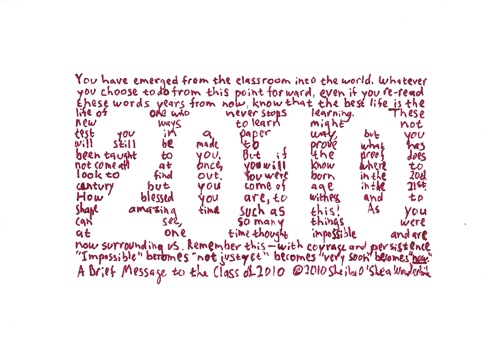
Since the space is intended as commercial space rather than a gallery, the lighting is not exactly amenable to an art show.  My brother graciously donated some lighting equipment that he’d had in storage and I spent the Monday before the show unpacking these large boxes and cataloging everything.  While I was there I met Ernest, my first proper art patron, and his sister, Margaret.  Margaret was impressed with my work and when I mentioned I did custom work as well, she offered to commission a piece as a gift for her niece, Ernest’s daughter Candace.  Ernest showed me the pictures he carried in his wallet of Candace–a pretty girl with a radiant smile, dressed in graduation robes.  We decided on the size (the equivalent of Fire Meets Water–seven square inches) and Margaret specified that she wanted the white space to be “2010” and the color to be burgundy, to match Candace’s class colors.

I pondered what to write for a day or two, drafted a few notions in my notebook and then began:

A Brief Message to the Class of 2010

A Brief Message to the Class of 2010

You have emerged from the classroom into the world.

Whatever you choose to do from this point forward, even if you re-read these words years from now, know that the best life is the life of one who never stops learning.

These new ways to learn might not test you in a paper way, but you will still be made to prove what has been taught to you.

But if the proof does not come all at once you will know where to look to find out.

You were born in the 20th century but you come of age in the 21st.

How blessed you are, to witness and to shape amazing time such as this!

As you can see, so many things were at one time thought impossible and are now surrounding us.

Remember this–with courage and persistence “Impossible” becomes “not just yet” becomes “very soon” becomes “now.”

I presented the result at the opening of Fringe Fest and both Margaret and Ernest were quite pleased.  I hope Candace will like it.

Prints of this work are available here.

The original has been purchased.

Word Art: Fire

I was told about the Doo-Nanny by Chris Hubbard, and figured at the very least I’d come back with some good stories to tell, so I went.  I did indeed come back with some good stories to tell, including the probably-more-epic-than-it-really-needs-to-be tale of how I managed to get a pair of Converse high-tops for two dollars, final bid, at the Possum Trot auction.

The Doo-Nanny, for those too lazy to click the link, is a festival of art, music, film and general craziness that is currently held on an 80-acre farm owned by one Butch Anthony, who is a folk artist, curator of the Alabama Museum of Wonder and perpetual wearer of overalls.  I described it to people as a sort of Southern-fried Burning Man.

I had a table set up there, and while I didn’t sell much, I got to meet all kinds of people who peered at my art and found it fascinating.  At one point, two ladies came up and asked me if I’d like to donate some art to burn in the Doo-Nanny.  The Doo-Nanny itself is a two-story bonfire that is ignited on Saturday night.  People drop things in there they are ready to let go of and they even auction off the opportunity to have a multi-course meal inside the Doo-Nanny a little while before it is burned.

I looked over my art table to see if there was something I was willing to abandon, but I decided instead to pull out a piece of paper I had handy and make something on the spot.

Fire

Fire

A flame fascinates as it burns to its conclusion.

We seek heat and light as we draw around it.

A flame terrifies as it burns without limits.

We beat it back if it goes beyond the boundaries we have set for it.

The fires of our hearts are always seeking a container to be kept in, whether as small a a candle flame or as massive as a bonfire.

And each fire contained so has the potential to ignite the heart of another into a fire of its own.

And so the flames are carried to hearts ignited, like the flames of candles at an Easter service, a lighting from one to the next to amplify a single candle’s flame to enough light to fill a cathedral.

Perhaps art movements should properly be called art conflagrations.

The blazing fires of genius are the kind to catch, to transform everything in its path into something quite different, quite different from what it was.

Here is a secret that we all know.

That creation and destruction are not absolutes.

They are value judgements applied to the process of change.

When a thing is changed into something we deem useful, we call it creation.

When the process of change results in something we have no use for, we call it destruction.

Each stroke of the pen obliterates the purity of the unblemished virginity of the blank sheet of paper.

The fires of the kiln strip all softness from the clay of a pot.

Every note of music, temporarily, it pushes aside the silence.

(And yet every moment of silence allows the music to be heard.)

Fire creates.  Fire destroys.  Fire transforms.

A new creation cannot exist without the destruction of that which came before it.

(Sometimes the one thing that holds us back from creating something new is the fear of what we may lose when we render it into being.)

One day all of this will be ashes.

Whether it’s when the trumpets blast from the heavens and God calls us all home or when the sun flares up in its final collapse, that which stands here will stand no more.

It is a rather terrifying thought for one to contemplate.

And yet it is a liberating one.

Against the length of eternity, we are as candle flames.

And yet how brightly we shine.

This moment flickers, gives off heat and light and then fades into darkness.

Keep it in your heart.

Tend to it.

And use it to light a new creation.

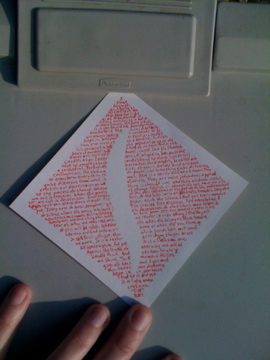
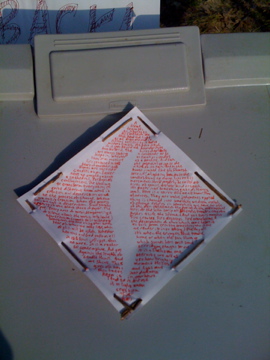
I typed all the words into a note on my iPhone so they wouldn’t be lost, and took a photograph to remember it by.  I didn’t have a frame handy, so I picked some thin twigs off the ground and improvised one.

A thing to be destroyed

Fire: Framed

I’d had it in my head that I would read the words on stage before dropping it in the Doo-Nanny, but the comedy of errors that went into getting the thing inside there was as much craziness as I could handle.  (Another long story.  Ask me and I’ll tell it to you sometime.)

Prints of this work are not available.

The original has been destroyed.

Originals on Hold

Hello to any new visitors who saw me at Riverfest!  I had a lovely time there and I hope to make it next year.

All my Etsy listings have been deactivated for the moment.  Sorry about that.  I’ve taken them down while the pieces in question are being set up for Art on the Fringe.  They will be for sale there beginning on Saturday, May 15, 2010.  I’ll be posting more details soon.

Links to prints should still be active and custom work is still available.  Thanks!

Word Art: Blue Blazing

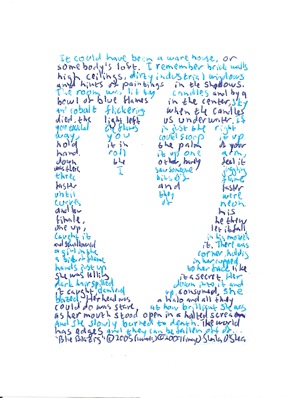
Writing in tiny wee writing is particularly well suited for framing in tiny wee frames.  One of my thrift shop runs provided me with a rather elaborate frame with a two-inch-by-three-inch window.  I decided, as an experiment, to see if I could fit a poem in it.  Since the poem itself wasn’t that long, I added some white space in the shape of a flame with the help of the French curves provided by my father.

The only word I had to omit from the original poem for it to fit the boundaries I’d set was the word “perfect.”

Blue Blazing

Blue Blazing

It could have been a warehouse,

or somebody’s loft.

I remember brick walls

high ceilings,

dirty industrial windows

and hints of paintings in the shadows.

The room was lit by candles

and by a bowl of blue flames in the center,

sky and cobalt flickering.

When the candles died, the light left us underwater.

If you touched the flames in just the right way, you could scoop some up

hold it in the palm of your hand,

roll it up one arm,

down the other, barely feel it was there.

I saw someone juggling three bits of flame

faster and faster

until they were [perfect] curves of neon,

and for his finale, he threw one up, let it fall

caught it in his mouth

and swallowed it.

There was a girl in the corner,

holding a bit of flame in her cupped hands just up to her face

like she was telling it a secret.

Her dark hair spilled down into and

it caught

clambered up,

consumed.

She blazed.

Her head was a halo and all they could do was stare

at how brilliant she was

as her mouth stood open in a halted scream

and she slowly burned to death.

The world has edges

and they can be fallen off of . . .

The poem had been previously published (albeit with a line missing) in the Java Monkey Speaks Volume One, which was an anthology of poets who had featured at the first two years of the Java Monkey Speaks reading.  My life as a poet has been a scattershot one, but I mark that as an achievement worth noting, up there with being published in another poetry anthology a few pages away from Neil Gaiman and having the opportunity to recite my work in front of a Basquiat painting at the High Museum of Art.

It’s one of the only free verse poems of mine I have memorized, so when I mention I did poetry at one time and people ask “So, what kind of poetry?” I’ve been known to recite that one and then say “stuff like that.”

Prints of this work are available here.

The original is not for sale.

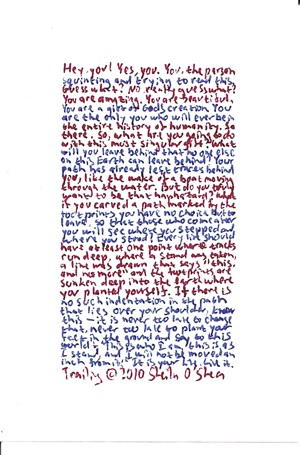
Word Art: Trailing

I’d bought a handful of small frames from a thrift superstore that opened recently near where I live.  This was made on a small piece of paper cut to fit that frame.  I started with two pens and the general idea to alternate colors with more lines per color as I progressed.  I pretty much did the whole thing in one sitting while listening to jazz at The Glenwood one fine Wednesday night.

Trailing

Trailing

Hey, you!

Yes, you.

You, the person squinting and trying to read this.

Guess what?

No, really, guess what?

You are amazing.

You are beautiful.

You are a gift of God’s creation.

You are the only you who will ever be in the entire history of humanity.

So there.

So, what are you going to do with this singular gift?

What will you leave behind that no one else on this Earth can leave behind?

Your path has already left traces behind you, like the wake of a boat moving through the water.

But do you truly want to be that haphazard?

What if you carved a path marked by the footprints you have no choice but to leave, so that those who come after you will see where you stepped and where you stood?

Every life should have at least one point where tracks run deep, where a stand was taken, a line was drawn that says “this, and no more” and the footprints are sunken deep into the earth where you planted yourself.

If there is no such indentation in the path that lies over your shoulder, know this–it is never too late to plant your feet in the ground and say to this world: “This is who I am, this is as I stand, and I will not be moved an inch from it.”

It is your life. Live it.

It was the first piece I ever sold.  At the opening of the Upper West Side Folk Art Market, even as the snow was coming down as thick and fast as I’ve ever seen it come in Atlanta, a few brave souls came out and one of those brave souls was a man named Ernest, who loved my work from the beginning and decided to buy a piece as a Valentine’s Day gift for his wife.  I read the words to him and the deal was sealed.  All seventeen dollars of it.

I promptly spent the money that very evening on a small bowl of Pho Tai at So-Ba and a cover charge to see two loud rock bands at 529.  (The Forty-Fives and The Howlies.  I highly recommend both of them.)  It was that kind of a night.

Prints of this work are available here.

The original has been sold.

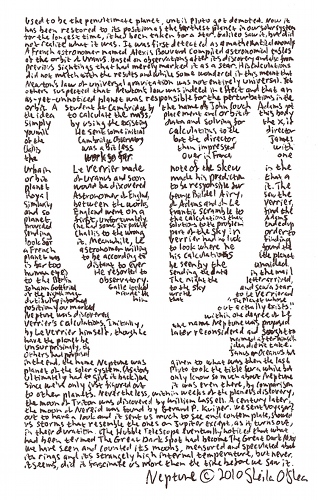
Word Art: Neptune [Astronomy Series]

By the time I’d gotten to Neptune, it was the fourth of the planetary Word Art pieces I had done on that particular Thursday and I was enormously relieved that Pluto was no longer on the list.  I was worried I wouldn’t find much to write about since its far distance meant that, like Uranus, there were no ancient myths surrounding it and not much in the way of exploration, either.  Fortunately, there was one thing that fascinated me–the astronomical race to be the first to officially discover the planet once the possibility of its existence came to light.

Neptune

Neptune

Used to be the penultimate planet, until Pluto got demoted.

Now it has been restored to its position as the farthest planet in our solar system.

For the longest time, it had been taken as a star.

Galileo saw it, but did not realize what it was.

It was first detected as a mathematical anomaly.

A French astronomer named Alexis Bouvard compiled astronomical tables of the orbit of Uranus, based on observations after its discovery and also from previous sightings that had merely marked it as a star.

His calculations did not match with the results and while some wondered if this meant that Newton’s law of universal gravitation was not entirely universal.

Yet others suspected that Newton’s law was indeed still in effect and that an as-yet-unnoticed planet was responsible for the perturbations in the orbit.

A student at Cambridge by the name of John Couch Adams got the idea to calculate the mass, placement and orbit of this body simply by using the existing data and solving for the x, if you will.

He sent some initial calculations to the director of the Cambridge Observatory but the director, James Challis, was a bit less than impressed with the work so far.

Over in France, one Urbain Le Verrier made note of the skew in the orbit of Uranus and soon made his prediction that a planet would be discovered to be responsible for it.

The Royal Astronomer of England, George Biddel Airy, saw the similarity between the works of Adams and of Le Verrier, and so England went on a frantic scramble to find the planet first.

Unfortunately, the calculations that Adams provided (he had some six possible solutions to the problem) ended up sending Challis to the wrong part of the sky in order to look for it.

Meanwhile, Le Verrier had no luck finding a French astronomer willing to look where he found the planet was to be according to his calculations (the planet is far too distant to ever be seen by the unaided human eye.)

He resorted to sending the data in the mail to the Berlin Observatory.

The night the letter arrived, Johann Gottfried Galle looked to the sky and saw a star of the eighth magnitude.

He wrote to Le Verrier and dutifully informed him that “The planet whose position you marked out actually exists.”

Neptune was discovered within one degree of Le Verrier’s calculations.

Initially, the name Neptune was proposed by Le Verrier himself, though he later reconsidered and sought to have the planet be named after himself.

Unsurprisingly, the idea didn’t take.

Others had proposed Janus or Oceanus, but in the end, the name Neptune was given to what was then the last planet of the solar system.

(As above, Pluto took the title for a while but ultimately had to give it back.)

We only know so much about Neptune since we’ve only just figured out it was even there, by comparison to other planets.

Nevertheless, within weeks of the planet’s discovery, the moon of Triton was discovered by William Lassell.

A century later, the moon of Nereid was found by Gerard P. Kuiper.

We sent Voyager 2 out to have a look and it sent us much to see and contemplate, showed us storms that resemble the ones on Jupiter except, as it turns out, in their duration.

(The Hubble Telescope eventually noticed that what had been termed The Great Dark Spot eventually had become the Great Dark Not.)

We have seen and counted its moons, measured and speculated about its rings and its strangely high internal temperature, but never, it seems, did it fascinate us more than the time before we saw it.

I finished a little before ten o’clock that night and was left both restless and exhausted.  Friday morning was spent doing last minute scanning and framing and packing all the planets up to take to Chattanooga with me.  None of them sold at the time, but I received many compliments on my work and it gave me some glimmer of hope that this crazy scribbly thing I do may will be of interest to others.

Prints of this work are available here.

The original is not for sale.