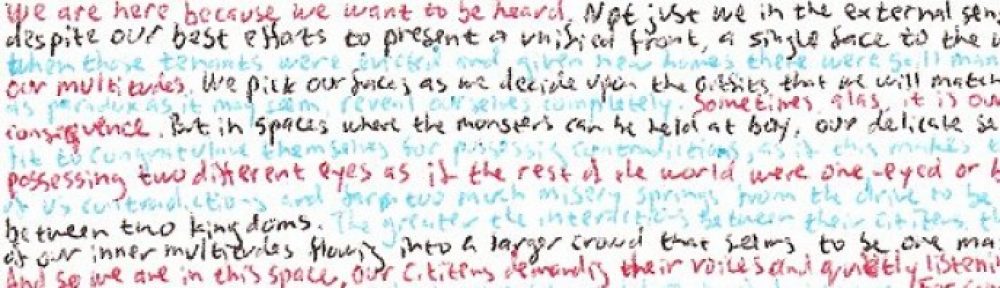
Word Art: Fire

I was told about the Doo-Nanny by Chris Hubbard, and figured at the very least I’d come back with some good stories to tell, so I went.  I did indeed come back with some good stories to tell, including the probably-more-epic-than-it-really-needs-to-be tale of how I managed to get a pair of Converse high-tops for two dollars, final bid, at the Possum Trot auction.

The Doo-Nanny, for those too lazy to click the link, is a festival of art, music, film and general craziness that is currently held on an 80-acre farm owned by one Butch Anthony, who is a folk artist, curator of the Alabama Museum of Wonder and perpetual wearer of overalls.  I described it to people as a sort of Southern-fried Burning Man.

I had a table set up there, and while I didn’t sell much, I got to meet all kinds of people who peered at my art and found it fascinating.  At one point, two ladies came up and asked me if I’d like to donate some art to burn in the Doo-Nanny.  The Doo-Nanny itself is a two-story bonfire that is ignited on Saturday night.  People drop things in there they are ready to let go of and they even auction off the opportunity to have a multi-course meal inside the Doo-Nanny a little while before it is burned.

I looked over my art table to see if there was something I was willing to abandon, but I decided instead to pull out a piece of paper I had handy and make something on the spot.
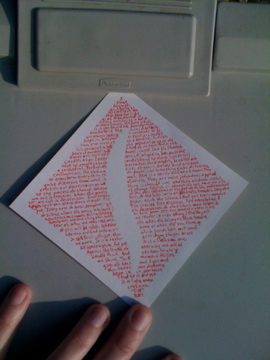
Fire

Fire

A flame fascinates as it burns to its conclusion.

We seek heat and light as we draw around it.

A flame terrifies as it burns without limits.

We beat it back if it goes beyond the boundaries we have set for it.

The fires of our hearts are always seeking a container to be kept in, whether as small a a candle flame or as massive as a bonfire.

And each fire contained so has the potential to ignite the heart of another into a fire of its own.

And so the flames are carried to hearts ignited, like the flames of candles at an Easter service, a lighting from one to the next to amplify a single candle’s flame to enough light to fill a cathedral.

Perhaps art movements should properly be called art conflagrations.

The blazing fires of genius are the kind to catch, to transform everything in its path into something quite different, quite different from what it was.

Here is a secret that we all know.

That creation and destruction are not absolutes.

They are value judgements applied to the process of change.

When a thing is changed into something we deem useful, we call it creation.

When the process of change results in something we have no use for, we call it destruction.

Each stroke of the pen obliterates the purity of the unblemished virginity of the blank sheet of paper.

The fires of the kiln strip all softness from the clay of a pot.

Every note of music, temporarily, it pushes aside the silence.

(And yet every moment of silence allows the music to be heard.)

Fire creates.  Fire destroys.  Fire transforms.

A new creation cannot exist without the destruction of that which came before it.

(Sometimes the one thing that holds us back from creating something new is the fear of what we may lose when we render it into being.)

One day all of this will be ashes.

Whether it’s when the trumpets blast from the heavens and God calls us all home or when the sun flares up in its final collapse, that which stands here will stand no more.

It is a rather terrifying thought for one to contemplate.

And yet it is a liberating one.

Against the length of eternity, we are as candle flames.

And yet how brightly we shine.

This moment flickers, gives off heat and light and then fades into darkness.

Keep it in your heart.

Tend to it.

And use it to light a new creation.

I typed all the words into a note on my iPhone so they wouldn’t be lost, and took a photograph to remember it by.  I didn’t have a frame handy, so I picked some thin twigs off the ground and improvised one.
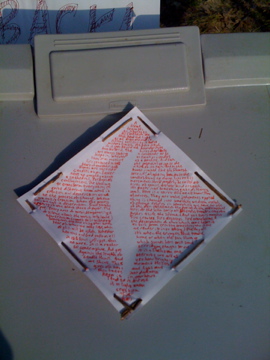
A thing to be destroyed

Fire: Framed

I’d had it in my head that I would read the words on stage before dropping it in the Doo-Nanny, but the comedy of errors that went into getting the thing inside there was as much craziness as I could handle.  (Another long story.  Ask me and I’ll tell it to you sometime.)

Prints of this work are not available.

The original has been destroyed.
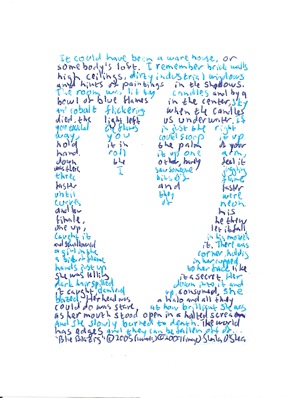
Word Art: Blue Blazing

Writing in tiny wee writing is particularly well suited for framing in tiny wee frames.  One of my thrift shop runs provided me with a rather elaborate frame with a two-inch-by-three-inch window.  I decided, as an experiment, to see if I could fit a poem in it.  Since the poem itself wasn’t that long, I added some white space in the shape of a flame with the help of the French curves provided by my father.

The only word I had to omit from the original poem for it to fit the boundaries I’d set was the word “perfect.”

Blue Blazing

Blue Blazing

It could have been a warehouse,

or somebody’s loft.

I remember brick walls

high ceilings,

dirty industrial windows

and hints of paintings in the shadows.

The room was lit by candles

and by a bowl of blue flames in the center,

sky and cobalt flickering.

When the candles died, the light left us underwater.

If you touched the flames in just the right way, you could scoop some up

hold it in the palm of your hand,

roll it up one arm,

down the other, barely feel it was there.

I saw someone juggling three bits of flame

faster and faster

until they were [perfect] curves of neon,

and for his finale, he threw one up, let it fall

caught it in his mouth

and swallowed it.

There was a girl in the corner,

holding a bit of flame in her cupped hands just up to her face

like she was telling it a secret.

Her dark hair spilled down into and

it caught

clambered up,

consumed.

She blazed.

Her head was a halo and all they could do was stare

at how brilliant she was

as her mouth stood open in a halted scream

and she slowly burned to death.

The world has edges

and they can be fallen off of . . .

The poem had been previously published (albeit with a line missing) in the Java Monkey Speaks Volume One, which was an anthology of poets who had featured at the first two years of the Java Monkey Speaks reading.  My life as a poet has been a scattershot one, but I mark that as an achievement worth noting, up there with being published in another poetry anthology a few pages away from Neil Gaiman and having the opportunity to recite my work in front of a Basquiat painting at the High Museum of Art.

It’s one of the only free verse poems of mine I have memorized, so when I mention I did poetry at one time and people ask “So, what kind of poetry?” I’ve been known to recite that one and then say “stuff like that.”

Prints of this work are available here.

The original is not for sale.

Word Art: Trailing

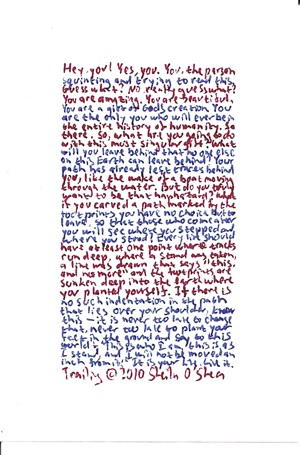
I’d bought a handful of small frames from a thrift superstore that opened recently near where I live.  This was made on a small piece of paper cut to fit that frame.  I started with two pens and the general idea to alternate colors with more lines per color as I progressed.  I pretty much did the whole thing in one sitting while listening to jazz at The Glenwood one fine Wednesday night.

Trailing

Trailing

Hey, you!

Yes, you.

You, the person squinting and trying to read this.

Guess what?

No, really, guess what?

You are amazing.

You are beautiful.

You are a gift of God’s creation.

You are the only you who will ever be in the entire history of humanity.

So there.

So, what are you going to do with this singular gift?

What will you leave behind that no one else on this Earth can leave behind?

Your path has already left traces behind you, like the wake of a boat moving through the water.

But do you truly want to be that haphazard?

What if you carved a path marked by the footprints you have no choice but to leave, so that those who come after you will see where you stepped and where you stood?

Every life should have at least one point where tracks run deep, where a stand was taken, a line was drawn that says “this, and no more” and the footprints are sunken deep into the earth where you planted yourself.

If there is no such indentation in the path that lies over your shoulder, know this–it is never too late to plant your feet in the ground and say to this world: “This is who I am, this is as I stand, and I will not be moved an inch from it.”

It is your life. Live it.

It was the first piece I ever sold.  At the opening of the Upper West Side Folk Art Market, even as the snow was coming down as thick and fast as I’ve ever seen it come in Atlanta, a few brave souls came out and one of those brave souls was a man named Ernest, who loved my work from the beginning and decided to buy a piece as a Valentine’s Day gift for his wife.  I read the words to him and the deal was sealed.  All seventeen dollars of it.

I promptly spent the money that very evening on a small bowl of Pho Tai at So-Ba and a cover charge to see two loud rock bands at 529.  (The Forty-Fives and The Howlies.  I highly recommend both of them.)  It was that kind of a night.

Prints of this work are available here.

The original has been sold.

Word Art: Neptune [Astronomy Series]

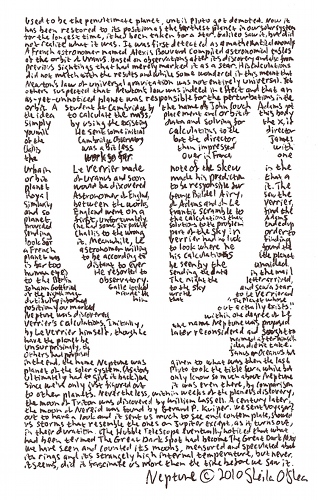
By the time I’d gotten to Neptune, it was the fourth of the planetary Word Art pieces I had done on that particular Thursday and I was enormously relieved that Pluto was no longer on the list.  I was worried I wouldn’t find much to write about since its far distance meant that, like Uranus, there were no ancient myths surrounding it and not much in the way of exploration, either.  Fortunately, there was one thing that fascinated me–the astronomical race to be the first to officially discover the planet once the possibility of its existence came to light.

Neptune

Neptune

Used to be the penultimate planet, until Pluto got demoted.

Now it has been restored to its position as the farthest planet in our solar system.

For the longest time, it had been taken as a star.

Galileo saw it, but did not realize what it was.

It was first detected as a mathematical anomaly.

A French astronomer named Alexis Bouvard compiled astronomical tables of the orbit of Uranus, based on observations after its discovery and also from previous sightings that had merely marked it as a star.

His calculations did not match with the results and while some wondered if this meant that Newton’s law of universal gravitation was not entirely universal.

Yet others suspected that Newton’s law was indeed still in effect and that an as-yet-unnoticed planet was responsible for the perturbations in the orbit.

A student at Cambridge by the name of John Couch Adams got the idea to calculate the mass, placement and orbit of this body simply by using the existing data and solving for the x, if you will.

He sent some initial calculations to the director of the Cambridge Observatory but the director, James Challis, was a bit less than impressed with the work so far.

Over in France, one Urbain Le Verrier made note of the skew in the orbit of Uranus and soon made his prediction that a planet would be discovered to be responsible for it.

The Royal Astronomer of England, George Biddel Airy, saw the similarity between the works of Adams and of Le Verrier, and so England went on a frantic scramble to find the planet first.

Unfortunately, the calculations that Adams provided (he had some six possible solutions to the problem) ended up sending Challis to the wrong part of the sky in order to look for it.

Meanwhile, Le Verrier had no luck finding a French astronomer willing to look where he found the planet was to be according to his calculations (the planet is far too distant to ever be seen by the unaided human eye.)

He resorted to sending the data in the mail to the Berlin Observatory.

The night the letter arrived, Johann Gottfried Galle looked to the sky and saw a star of the eighth magnitude.

He wrote to Le Verrier and dutifully informed him that “The planet whose position you marked out actually exists.”

Neptune was discovered within one degree of Le Verrier’s calculations.

Initially, the name Neptune was proposed by Le Verrier himself, though he later reconsidered and sought to have the planet be named after himself.

Unsurprisingly, the idea didn’t take.

Others had proposed Janus or Oceanus, but in the end, the name Neptune was given to what was then the last planet of the solar system.

(As above, Pluto took the title for a while but ultimately had to give it back.)

We only know so much about Neptune since we’ve only just figured out it was even there, by comparison to other planets.

Nevertheless, within weeks of the planet’s discovery, the moon of Triton was discovered by William Lassell.

A century later, the moon of Nereid was found by Gerard P. Kuiper.

We sent Voyager 2 out to have a look and it sent us much to see and contemplate, showed us storms that resemble the ones on Jupiter except, as it turns out, in their duration.

(The Hubble Telescope eventually noticed that what had been termed The Great Dark Spot eventually had become the Great Dark Not.)

We have seen and counted its moons, measured and speculated about its rings and its strangely high internal temperature, but never, it seems, did it fascinate us more than the time before we saw it.

I finished a little before ten o’clock that night and was left both restless and exhausted.  Friday morning was spent doing last minute scanning and framing and packing all the planets up to take to Chattanooga with me.  None of them sold at the time, but I received many compliments on my work and it gave me some glimmer of hope that this crazy scribbly thing I do may will be of interest to others.

Prints of this work are available here.

The original is not for sale.

Word Art: Peering Through the Eye

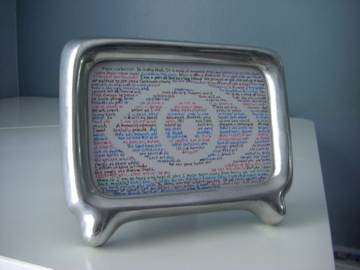
At this point, I don’t have my artwork framed professionally but make use of standard photo frames from thrift shops and dollar stores.  Not only am I too broke to afford much more, I prefer to be able to remove the art easily in order to scan it or make minor corrections.

I picked up a frame on one of my thrift shop runs that resembled a television screen and made an earlier attempt to fill it with words that would look like static but I got bored with what I was doing about a third of the way through it and abandoned it.  I started again, this time coming up with an eye design in GIMP and tracing the printout.  I got about halfway through it and set it aside before finally finishing it up over a glass of bourbon at a brewpub within walking distance of my home.

Peering Through the Eye

Peering Through the Eye

There is a barrier.

It is this thick.

It is made of magazine pages and television screens, layer upon layer upon layer.

Something like glass.

What is seen is distorted.

You ripple when you move.

It makes you beautiful.

I am a part of the swirling crowd.

We struggle to get close enough to touch, or at least to see just a little more clearly.

You are surrounded from so many angles and each flat image provides an addition to a composite assembling in my mind.

I try to even take in the ugly moments, the pettiness, the flaws and fumblings.

They console me so, remind me that you are human, and I am given a sense of being close enough to see you vulnerable, even as I am not the only witness to such things.

It can still feel like a secret that has been shared just between the pair of us.

At times it can feel as if my broken up places are known just as clearly to you, in the ways you sing or speak.

These are only illusions.

And yet we crave them so.

I use the newspapered pages to patch up the cracks in my heart.

I weave your glamour into a net in order to hold myself in place.

It is a willing sort of bondage.

Indeed, you never even asked it of me.

And yet I am yours to call upon.

You ask so little of one who would give so much.

A moment’s attention would be such tiny payment in exchange for all that I would so gladly provide.

And yet there are many others who would do the same and all those tiny moments add up, become minutes, become hours, become days and you would have no time left to do anything at all.

And so those flickers of your regard become as precious and rare as jewels, cut to shine, treasured and worn as symbols of status.

We sometimes carve ourselves some kind of semiprecious substitute out of daydream and creativity.

(It is a harmless enough practice as long as one is not foolish to the point of delusion that they are the same as the genuine article.)

There are days when I dream of ascending to the ranks of those whose moments of attention are carved into jewels.

I dream of being surrounded by the same layers that surround you, the screens, the pages, the camera lenses.

I dream of being that much closer to you, close enough for you to see me clearly.

(And yet I know that if I am to have any hope of that I must turn away from facing you and turn to face myself.)

Until then, I settle for the fishbowl flickers when I get close enough to press my hand against the glass.

It seems warmer where you are.

Do you really see me when I stand so close?

Can you see me ripple when I move?

Am I, dare I hope, made beautiful?

The first seven lines had been composed in my head as the start of a poem and stayed in limbo for many years.  Writing them down as the start of this piece forced the issue.  I did a bit of notebook drafting for this one but, as always, the words tended to shift a bit between initial composition and execution.

Is it about anyone in particular?  It is, in a sense, about a lot of people, about the nature of celebrity obsession as I have experienced it and witnessed it.  I can’t imagine a better frame for it, really.

Prints of this work are available here.

The original is not for sale.

Word Art: Uranus [Astronomy Series]

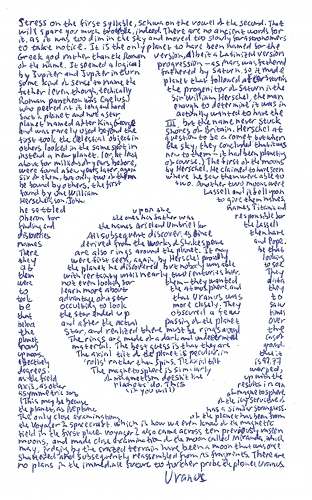
This planet is, of course, the one that makes schoolboys snicker upon the mere mention of the name.  The symbol only makes it worse, I fear–all you’d need to do is add a pair of hands and you’d practically have a pictogram for goatse.

Uranus

Uranus

Stress on the first syllable, schwa on the vowel of the second. That will spare you much trouble, indeed.

There are no ancient words for it, as it was too dim in the sky and moved too slowly for astronomers to take notice.

It is the only planet to have been named for the Greek god rather than the Roman version, albeit a Latinized version of the name.

It seemed a logical progression–as Mars was fathered by Jupiter and Jupiter in turn fathered by Saturn, so it made some kind of sense to name the planet that followed after Saturn’s father (even though, technically the progenitor of Saturn in the Roman pantheon was Caelus.)

Sir William Herschel, the man who peered at it long and hard enough to determine it was in fact a planet and not a star, actually wanted to have the planet named after King George III, but the name never stuck and was rarely used beyond the shores of Britain.

Herschel at first took the celestial object in question to be a comet, but when others looked in the same spot in the sky, they concluded that it was instead a new planet.

(Or, at least, new to them–it had been planeting about for millions of years before, of course.)

The first of the moons were found a few years later, again by Herschel.

He claimed to have seen six of them, but only two of them where he saw them were able to be found by others, the first two.

Another two moons were found by one William Lassell and it fell upon Herschel’s son, John, to give them names.

He settled upon the names Titania and Oberon for the ones his father was responsible for finding and the names Ariel and Umbriel for the Lassell discoveries.

All subsequent discoveries since then have names derived from the works of Shakespeare and Pope.

There are also rings around the planet.

It may be that they were first seen, again, by Herschel proudly looking at the planet he discovered, but nobody was able to see them with certainty until nearly two centuries later.

They were not even looking for them–they wanted data to learn more about the atmosphere and they took advantage of a star that Uranus was to be occulting to look more closely.

They saw that the star ended up obscured a few times before and after the actual passing of the planet over the star, and realized that there must be rings around the planet.

The rings are made of a dark and undetermined (as of now) material.

The best guess is that they are ground up moons.

The axial tilt of the planet is peculiar, in that it effectively ‘rolls’ rather than spins.

The axial tilt is 97.77 degrees. The magnetosphere is similarly warped, as the field of magnetism doesn’t line up with the axis, as other planets do.

This results in an asymmetric sort (if you will) of magnetosphere.

(This may be because of the icy structure of the planet, as Neptune has a similar strangeness.)

The only close examinations of the planet has [sic] been from the Voyager 2 spacecraft, which is how we even know of the magnetic field in the first place.

Voyager 2 also came across ten previously unseen moons, and made close examination of the moon called Miranda, which may, judging by the crazed terrain have been a moon that was once shattered and subsequently reassembled from its fragments.

There are no plans in the immediate future to further probe the planet Uranus.

Yes, you’re absolutely right, I didn’t have to go there, but understand that this was after I’d just finished Jupiter and Saturn in a mad dash to finish the planets by the end of Thursday and I was eager to finish it so I could move on to Neptune and be done with it.  So I went for the dumb joke.  Sorry about that.

Prints of this work are available here.

The original is not for sale.

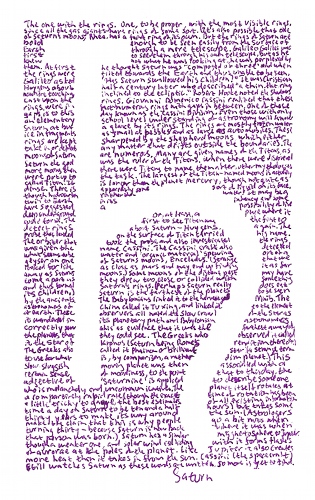
Word Art: Saturn [Astronomy Series]

Last night I met someone–the new friend of an old friend–who had a symbol for Saturn worked into a tattoo on his arm.  It was, to my momentary bafflement, entirely unlike the symbol for Saturn that I’d traced and rendered into Word Art.  The symbol he’d chosen was one that dated back to Medieval times whereas the one I’d used had been swiped from the NASA website.  It struck me as an interesting object lesson in the mutability of symbols over time.

Saturn

Saturn

The one with the rings.

One, to be proper, with the most visible rings, since all the gas giants have rings of some sort.

(It’s also possible that one of Saturn’s moons, Rhea, has a faint ring of its own.)

But the rings of Saturn are bold enough to be seen easily from the surface of Earth through a mere telescope.

Galileo Galilei was first to see them through his own telescope, but as he knew now what he was looking at, he was perplexed by them.

At first he thought Saturn was “composed of three” and when the rings were tilted towards the Earth and thus unable to be seen, Galileo asked “Has Saturn swallowed his children?”

It was Christian Huygens, about half a century later who described “a thin, flat ring, nowhere touching, inclined to the ecliptic.”

Robert Hooke noted the shadows cast upon the rings.

Giovanni Domenico Cassini realized that these rings were in fact numerous rings with gaps in between.

One of these gaps is to this day known as the Cassini Division.

Even those with only an elementary school level understanding of astronomy will know Saturn at but a glance by its rings.

The rings are mostly frozen water ice in fragments as small as pebbles and as large as automobiles.

These rings are kept sharpened by the shepherd moons, which either take in or deflect any matter that drifts outside the boundaries.

The moons of Saturn are numerous. Many are given names of the Titans as Saturn the god was the ruler of the Titans.

When there were discovered more moons than there were Titans to name them after, other mythologies were put up to the task.

The largest of the Titan-named moons is actually called Titan. It is larger than the planet Mercury, though not quite as dense.

There is apparently some sort of liquid on its face, though hydrogen rather than water.

It may be a twin to Earth in its infancy and some have suggested a possibility of life deep underground.  Or, at least, a place where it could form.

The first to see Titan was the first to detect rings about Saturn–Huygens, again.

The probe that landed on the surface of Titan carried his name.

The orbiter that took the probe and also investigated the rings was given the name Cassini.

The Cassini craft also detected what seems to be water and ‘organic material’ spewing out of a geyser on one of Saturn’s moons, Enceladus.

(Strange that we looked for life as close as Mars and may end up finding it as far away as Saturn’s moons.)

Some moons of the distant past may have come apart as they drew too close or collided with something and thus formed Saturn’s rings.

(Perhaps Saturn really does eat its children.)

Saturn is the farthest of the planets to be seen by the ancients.

The Babylonians linked it to the harvest god Ninib.

The astronomers of China called it Tu Xing, and linked it to the element of earth.

These observers all noted the slow crawl of the star as it wandered on its planetary path and Babylonian astronomers correctly saw this as evidence that was the farthest away of the planets that they could see.

The Greeks also observed it, called it the star of Kronos (Saturn being Rome’s rendition thereof.)

The Greeks also called it Phainon or brilliant star (a strange term for what is, by comparison, a rather dim planet.)

This slow, sluggish moving planet was then associated with a certain sense of moodiness, to the point that to this day, the adjective of ‘saturnine’ is applied to describe someone who is melancholy and uncommunicative.

The planet itself rotates at a comparatively rapid rate (though the exact time of rotation as been a little tricky to gauge, the best estimates of all existing information time a day on Saturn to be ten and a half hours) but takes some thirty years to make its way around the sun.

(Astrologers make the claim that this is why people go a bit nuts when turning thirty–because Saturn is now back where it was when that person was born.)

Saturn has a similar magnetosphere to Jupiter, though a weaker one, and solar wind colliding with it forms flashes of aurorae at the poles of the planet.

Like Jupiter it also creates more heat than it takes from the Sun.

Cassini (the spacecraft) still watches Saturn as these words are written, so more is yet to find.

Since I’d done the planets in order starting from Mercury and working my way out to Neptune, I found myself occasionally referring back to previous planets as I progressed.  Since much of the words around Mars centered on the possibilities of life there I couldn’t resist making note that there are apparently better chances of life in the vicinity of Saturn according to current research.

Prints of this work are available here.

The original is not for sale.

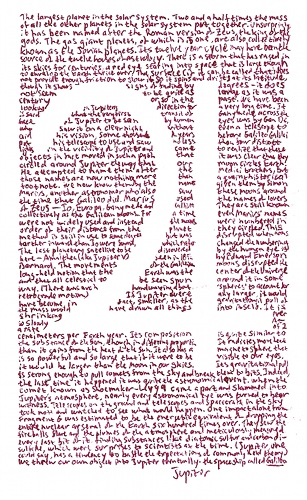
Word Art: Jupiter [Astronomy Series]

Jupiter was the first planetary symbol that, blessedly, didn’t saddle me with the tricky business of filling in words around a circle.  It’s also not a symbol that has too many pop-cultural associations, so people either know what it is on sight or have no idea whatsoever.

I started it on Thursday morning, the day before I was supposed to take the work to Chattacon.  Procrastination had once again backed me into a corner and I prayed to make it at least as far as Saturn by the end of the day.  (Fortunately, I made it all the way to Neptune.)

Jupiter

Jupiter

The largest planet in the solar system.

Two and a half times the mass of all the other planets in the solar system put together.

Unsurprisingly, it has been named after the Roman version of Zeus, the king of the gods.

The gas giant planets, of which this is one, are also collectively known as the Jovian planets.

Its twelve year cycle may be been the source of the twelve houses of astrology.

There is a storm that has raged in its skies for centuries, a red eye staring into space that is large enough to envelop the Earth thrice over.

The surface (if it can be called that) does not provide enough friction to slow it, so it spins and drifts at its latitude, though it shows signs of fading by degrees–it does not seem to be quite as large as it was a century or so in the past.

We have been looking in Jupiter’s direction for a very long time.

It is said that the very first transit of Ganymede across the face of Jupiter to be seen by human eyes was by Gan De, who saw it on a clear night without even a telescope to aid his vision, some thousands of years before Galileo Galilei put his telescope to use and saw no less than four distinct lights in the vicinity of Jupiter and came to realize that these objects in fact moved in such a path that it was clear that they circled around Jupiter the way that our moon circles Earth.

He attempted to name them after the Medici brothers, but those names are now nothing more than a quaint historical footnote.

We now know them by the name given them by Simon Marius, another astronomer who also saw these moons around the time that Galileo did.

Marius used the names of lovers of Zeus–Io, Europa, Ganymede and Callisto.

They are still known collectively as the Galilean moons.

For a time even Marius’ names were not widely used and instead the moons were numbered in order of their distance from the planet they circled.

This method is still in use to some degree but was disrupted when moons farther inward than Io were found, which rather changed the numbering.

The last planetary satellite to be discovered by the human eye is here–Amalthea (aka Jupiter V) seen in 1892 by Edward Emerson Barnard.

The movements of the Galileian moons disrupted the long-held notion that the Earth was the center of the Universe and that all celestial to be seen spun around it in some way.

(There was much handwaving about ‘spheres’ to account for retrograde motion.)

If Jupiter were any larger, it would have become, in fact, smaller, as the gravitational pull of the mass would have drawn all things into itself.

It is shrinking ever so slowly. At a rate of 2 centimeters per Earth year.

Its composition is quite similar to the substance of the Sun, though in different proportion.

It radiates more heat than it gains from the heat of the Sun.

It also has a magnetosphere that is so powerful and so large that if it were to be visible to our eyes, it would be larger than the Moon in our skies.

Its gravitational pull is strong enough to pull comets from the sky and break them to bits.

Indeed, the last time it happened it was quite the astronomical event.

When the comet known as Shoemaker-Levy 9 came apart and slammed into Jupiter’s atmosphere, nearly every astronomical eye was turned to bear witness.

Telescopes on the ground and telescopes and spacecraft in the sky took note and watched to see what would happen.

One impact alone from Fragment G was estimated to be the energetic equivalent of dropping the entire nuclear arsenal of the Earth six hundred times over.

They saw the fireballs flare and the plumes of the atmosphere and meticulously measured every last bit of it, finding substances like diatomic sulfur and carbon disulfite, which were surprises to scientists at the time.

(Jupiter, one could say, has a tendency to baffle the expectations of commonly held theory.)

We threw our own object into Jupiter eventually–the spaceship called Galileo.

Again, facts were written in roughly in order of what looked interesting, from historical discoveries to the red eye storm to the sheer delightful geekery of Comet Shoemaker-Levy 9 and those who watched to see it collide with the planet.  By this point, I’d gotten better at figuring out roughly how much information to gather in advance in order to fill the 3-inch-by-5-inch spaces designated for the text, which sped the process up considerably.

Prints of this work are available here.

The original is not for sale.

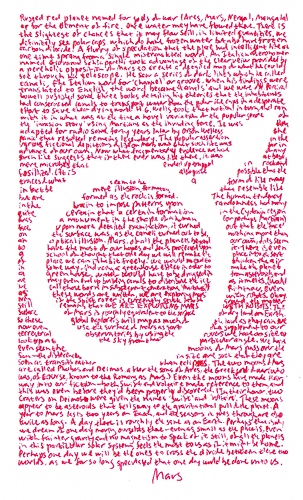
Word Art: Mars [Astronomy Series]

I am not a scientist and have no immediate plans to become one, so when gathering the information to fill in the spaces on the planetary series I’m more interested in the cultural implications of the planets than I am in the statistics of the bodies themselves.  Mars is a good example of this.

Mars

Mars

Rusted red planet named for gods of war (Ares, Mars, Nergal, Mangala) or for the element of fire.

Once water may have flowed there. There is the slightest of chances that it may flow still, in limited quantities.

We definitely see polar caps, which do have frozen water but also have frozen carbon dioxide.

A flurry of speculation that the place had intelligent life at one time sprang from a single mistranslated word.

An Italian astronomer named Giovanni Schiaparelli took advantage of the clear view provided by a perehelic opposition of Mars to create a detailed map of what he could see through his telescope.

He saw a series of dark lines which he called canali, the Italian word for ‘channel’ or groove.

When his findings were translated to English, the word became ‘canals’ and we were off.

Percival Lowell published some three books detailing his theories that the inhabitants had constructed canals to transport water from the polar ice caps in a desperate effort to save their dying world.

H. G. Wells took that notion in turn, and ran with it in what was at the time a novel variation of the popular genre of the ‘invasion story’ using Martians as the invading force.

It was then adapted for radio some forty years later by Orson Welles; the panic that resulted remains legendary.

The popular assertion in the various fictional depictions of life on Mars was that such life was far in advance of our own.

Now what fragmentary evidence we have of any such life suggests that if were ever was life there, it was at best mere microbes that ended up trapped in rock and fosillized. [sic]

It is also quite possible that the traces of what seem to be a form of life may in fact be mere illusion, formations that resemble life but are formed as the rock is formed.

The human tendency in the brain to impose patterns upon randomness had many quite certain that a certain formation in the Cydonian region was a monument in the shape of a human (or perhaps Martian) face.

Upon more detailed examination, it turned out that the ‘face’ on the surface as, as the canali turned out to be, nothing more than an optical illusion.

Mars, of all the planets beyond our own, does seem to have the most of our hopes and fears projected upon it.

There is even a school of thought that one day we will remake the place into the sort of place we can inhabit freely.

We would need to thicken the air in some way, inducing a greenhouse effect in order to make the planet a greenhouse.

Water would have to be dragged in from asteroids and we may even end up building canals to distribute the ice as it melts.

(Would we call those born in subsequent generations ‘Martians’?)

Right now, even as these words are written, we are exploring Mars with robots.

Okay, even if the Spirit rover is currently stuck in soft ground, the matter still remains that WE ARE EXPLORING MARS WITH ROBOTS!

The surface of Mars is roughly equivalent to the surface of dry land on Earth, so these global explorers will map as much of the land as they can.

We now even use the surface of Mars as sort of a supplement to our terrestrial observatories by using the rovers we have on site to look up at the sky from that particular angle.

We have even seen the moons of Mars pass over the sun–the differences in size are such that they are seen as transits rather than eclipses.

The two moons of Mars are called Phobos and Deimos, after the sons of Ares, the Greek god of war (who was, of course, known to the Romans as Mars.)

Even the moons have made their way into our fiction–both Swift and Voltaire made reference to them, and this was even before they’d been properly discovered.

(In their honor, two craters on Deimos were given the names ‘Swift’ and ‘Voltaire’.)

These moons appear to be asteroids that fell sway to the gravitational pull of the planet.

A year to Mars lasts two years on Earth, and the seasons it goes through are also twice as long.

A day there is roughly the same on Earth.

Perhaps that is why we dream of one day moving ourselves there–even as small as the place is, even with fainter gravity and no magnetism to speak of it still, of all the planets in this particular solar system, feels the most to us as if it might be home.

Perhaps one day we will be the ones to cross the divide between these two worlds, as we far so long speculated that one day would be done unto us.

The trickiest part was coming up with turns of phrase that would allow for very short words just where the edge of the image met the edge of the circle.  I seem to have managed.  And, yes, I did shift a bit in tone when I went all enthusiastic about the whole Exploring Mars With Robots thing but what can I say?  It still blows my mind that I can say that out loud and be telling the truth.

Prints of this work are available here.

The original is not for sale.

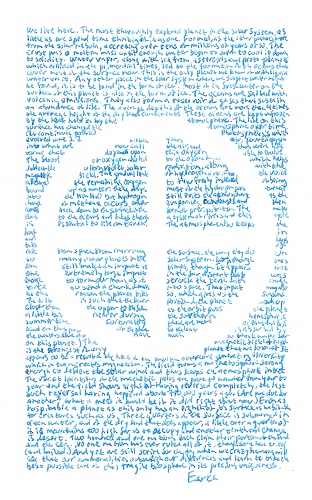
Word Art: Earth [Astronomy Series]

We don’t spend much time thinking about Earth being as much an astronomical body as any other planet in space, and I said as much in the text.  This one was both easier and harder than the other planets because of that.

Earth

Earth

We live here.

The most thoroughly explored planet in the Solar System, as little as we spend time thinking of it as one.

Formed, as the other planets were, from the solar nebula, accreting over tens of millions of years or so.

The crust was a molten mass until enough water begin to form to cool it down to solidity.

Water vapor, along with ice from asteroids and proto-planets which collided in the primordial times, led to the formation of the oceans that cover most of the surface now.

This is the only planet we know of with liquid water on it.

Any other place in the solar system where we suspect water might be found, it is to be found in the form of ice.

Most of the fresh water on the surface of this planet is also in the form of ice.

The oceans are salted with volcanic emissions.

They also form a reservoir of gases that sustain an abundance of life.

The average depths of the oceans are more than 4 times the average height of the dry land continents.

These oceans are kept unfrozen by the heat held in by the atmosphere.

The life on this surface has changed the atmosphere over time. (It continues to do so.)

Photosynthesis which evolved some 2.7 billion years ago, poured oxygen into what we now call the air, and thus were life forms that depend upon this oxygen able to evolve.

The flood of oxygen also led to the ozone layer which helps deflect the ultraviolet solar radiation, along with the magnetic field.

The gradual leak of hydrogen out into the void allowed the remaining oxygen to flow freely instead of being bound up as water.

These days most of the hydrogen gets turned into the H in H20, but hydrogen still exists in the atmosphere as the change of methane occurs.

Water evaporates, condenses and then comes back down to the surface in the form of precipitation.

The water flows to the oceans and lakes through a system of rivers and this cycle is essential to life on Earth.

The atmosphere also keeps the heat in and keeps bits of rock from space from marring the surface, the way they do on so many other planets in the solar system.

Large enough ones can still make an impact at times, though.

It appears that one extremely large impact in the far distant past was enough to form our Moon, as it struck the Earth with enough force to send a chunk of mass into space.

That impact may also be the reason this planet tilts so, which gives us the seasons.

The tilt is such that the lower portion of the planet winds up closer than the upper to the sun as the orbit puts the planet a little bit nearer during the southern hemespheric [sic] summertime.

Fortunately, there are more oceans and less land on that part of the planet so the heat is absorbed by the waters.

(We do have much to thank water for on this planet.)

The magnetic field of Earth is the strongest of any planet that we know of.

It appears to be a result of the heat of the molten outer core generating electricity which in turn creates magnetism.

The field forms a magnetosphere strong enough to deflect the solar wind and this keeps the atmosphere intact.

The exact locations of the magnetic poles are prone to wander from year to year and the field shows signs of having reversed completely, the last such reversal having happened about 780,000 years ago.

(Are we due for another? What a mess it would be if it did right about now.)

Even as hospitable a planet as this only has an eighth of its surface as habitable for creatures such as us.

Three quarters of the surface is submerged in ocean water, and of the dry land that does appear, a little over a quarter of it is mountains too high for us to occupy and another tenth and change is desert.

Two hundred and one nations each claim their portion of the land and the sea.

No one nation has ever ruled all of it, though some have tried (and failed.)

And yet we still strive for the day when we crazy humans will see that our commonalities outweigh our differences and learn to take the best possible care of this fragile biosphere in its precious uniqueness.

I could do it in no other color than blue.  It is the only planet I did in blue, understandably.  Alas, my Nice Light Blue Pen got lost in a bar somewhere when I was working out in the world and I had to use an imperfect substitute for this piece.  It seemed to have sufficed.

Prints of this work are available here.

The original is not for sale.