Closing a Tab

This site used to have four tabs—Arrival Point, Books, Q&A and Ten Thousand Flowers. If you look up at the top of the page, you’ll notice that the “Books” tab is gone.

“Books” was for my wee little book Catbooks and Other Methods: Free Writing Techniques To Clear Your Head, Improve Your Mood and Make Waiting At the Dentist’s Office Just a Little More Bearable. It came out via Lullwater Press, which was basically the micropress my father set up to put out a textbook on nursing that my mother had written. He let me put out the book under that aegis, though I did most of the work involved, so it was functionally self-published.

I put it out in 2011 and to this day it has not sold enough copies for me to collect on the money it earned. It’s easy to explain why—I barely told anybody about it. Perhaps on some level I realized it wasn’t that good. It was created in what was likely a fit of hypomania and was pretty much assembled from blog posts I made here with a few additions, making it more of a chapbook than anything.

When I set up the page, I promised two more books to be eventually released, with titles that changed over time. One ended up being called How to be a Bazzillionare: Why You Don’t Need to be a Rich Person to Live a Rich Life; the other was Taming the NoMonster: How to Do the Things That You Don’t Want to Do. The former was to be a compilation and expansion of the “Rich Living” posts on this very blog; the latter was an intended treatise on how to stop procrastinating.

I’m abandoning both projects, and pulling down Catbooks very soon. I came to realize that all of them were rooted in the hypomanic arrogance that is I’ve Got It All Figured Out and Here’s How to Do It. Even if I do have it figured out, the only person I have it figured out for is myself. I had done no research to support my claims beyond my own experience, which isn’t helpful to a wide audience because what works for my bipolar-ass brain and unconventional life story isn’t too likely to work for anybody else.

Plus, I’m working on other books, fictional ones that I hope will please others the way they please me. (You can find them, or will find them when I at least release the first one at http://sarashay.com.) I’ve done more work to research those than I have for any of my self-help efforts, and I’m having much more fun writing them.

I don’t regret putting out Catbooks, because it gave me a crash-course in self-publishing and an object lesson in the importance of self-promotion. But it’s time to close those open loops in my head so I can focus on things I have genuine authority on.
Rich Living: Away From the Screens

I have an iPhone. I do not complain about this. I’m slowly learning Spanish with Duolingo, and I was able to lose all the weight that medication had put on me with LoseIt. But social media was threatening to become my downfall. I was checking things constantly and ignoring the world around me, which made me a bit of a hypocrite in terms of Presence. There was also a compulsive quality that I didn’t like about it. I’ve had soft addictions like that before, and eventually they stopped making me happy. It’s one of the reasons I left Facebook.

So I decided I needed to do something about it. I offer it to anybody else who would like to cut down on their social media intake and spend a little more time in Presence.

Before I had an iPhone to fill in the dull moments like waiting in line, I had a catbook to write in.  I still do. Any time I venture into the world, I have these four things in my pockets or purse–keys, wallet, iPhone and catbook. (I once explained my habit to a friend of mine by putting the catbook on the bar we were sitting at and saying “These are my cigarettes.” and then putting the pen next to it and saying “This is my lighter.”)

This is what I do–I stop myself from going through my social media streams by barring myself from doing so until I have written something in my catbook first. Or written anywhere–my diary, one of my blogs, a Sub-C session, or one of the composition books where I hash out notes for novels. I also use my ToDo app to earn a round of social media. I have tasks that renew daily ranging from “exercise” and “take meds” to “work on current writing project” and “practice guitar.” If I perform one of those tasks, I get to check my streams.  If I do two things in a row, I do not earn two sessions back to back–I get to do one, and then I have to earn a fresh one before I can go at it again.

When I’m out, I pretty much stick to the catbook to earn my social media session, except in emergencies like being in a dimly lit club where I can’t see the page clearly. Then I use Day One to pour out my seething brain. You can also use whatever kind of note-taking app that comes with your phone, if you’d rather not spend the money.

With the time that’s freed up, you can enjoy your surroundings and talk to the people in your vicinity. Unless, of course, they’re bent over their own phones.

Rich Living: One Sense at a Time

Much has been written about presence and mindfulness, so I won’t bore you be repeating it.  Instead I’ll simply cut directly to a technique I use to bring myself into the present moment.

Presence is when we get out of the ramblings of our heads and fully occupy the world around us.  Focusing on the senses is a common practice in mindfulness.  But it didn’t occur to me until quite recently that I don’t have to focus on all my senses at once to experience presence.  One sense at a time will do.

The one I use the most often is hearing.  When I make I cup of tea, I listen to the water pouring into the kettle, the clank of the kettle as I put it on the stove and the chime of the spoon against the inside of the cup as I stir the sugar in.  When I wash my hands, I hear the rush of the water and the flow of it down the drain.  When I can hear them, I listen to my footsteps.  Or the whirr of the fan in the space heater.  Or the whisper of the leaves outside my window.  I also notice the silences between each sound, and the murmury noises that keep things from being completely silent.

I also take in the things I see.  I notice the colors and textures of things and look at their shapes.  I can see how those shapes fit together–the table, the books on the table, the covers on the books, the shapes and colors on the covers of the books.  The important thing is to see the thing and stop there, without getting caught up in what the thing is or how you feel about it.  Writing is particularly distracting, but I can always read and then refocus on the visual.

We often ignore the sense of touch.  We notice it when we brush our fingertips against things, but every inch of our skin is laden with nerves that detect heat, cold, pressure, pleasure and pain.  Sometimes I go beyond my fingertips and feel my clothes against my skin.  I feel the ground against the soles of my feet as I walk, even with the intermediary of shoes.  When I’m driving, I’ll feel the steering wheel in my hands and my seat underneath me.  I feel the heat or the cold from the heater or air conditioning.  All of this brings my body and mind into the present, where everything happens.

The essence of rich living is to fully occupy your life, which you can’t do if you’re not paying any attention to it.  Engaging your senses allows you to capture all the miracles around you without letting them slip past.  Try it sometime and see how it works for you.

Rich Living: Unwandering the Mind

I’m fixing a hole where the rain gets in

And stops my mind from wandering

Where it will go

–The Beatles, “Fixing a Hole”

The mind wanders.  Whether this is a bug or feature depends perhaps on when it wanders and where it wanders to.  It can make tedious situations bearable and can bear the seedlings of great ideas.  But daydreaming can also lead to spirals of thought that send one veering downwards into worry and depression, especially when it gets stuck on one particular thing.

There are a lot of techniques for pulling out of that tailspin–meditation, mindfulness and so on–but there’s one that I stumbled on that I carry in my pocket that may be of some use to you.

In brief, it involves talking back to the wandering mind.  In detail, I’ve come up with a number of phrases–you can modify them to ones that work for you, of course, but feel free to use these as starting points–to interrupt the line of thought and shift myself back into the present.

“But that will never happen.”

“That’s not the way it happened.”

“It’s over and I can’t change it.”

But that will never happen

One of my most common wanderings involves conjuring up worst case scenarios for things in the future or somethings even in the present.  They can be theoretically possible things, or completely outlandish ones.  Either way, they are anxiety inducing and tend to catch up the mind in all kinds of ruminations–I’m going to fall and break this thing I’m carrying, they’re going to hate me, I’m going to say something incredibly rude.  (These are examples of worst case scenarios that I have indeed gotten my head stuck on.)  The antidote is a simple phrase: “But that will never happen.”  All at once, the daydream nightmare (daymare?) dissolves and the mind, with nowhere else to be, returns to the present moment.

Sometimes the thing I’m thinking about is a future event that will happen to me.  A meeting with the boss, for example.  I might find myself rehearsing the things I’m going to say and imagining the things my boss is going to say.  More often than not, I find myself mentally defending against the harshest possible questions.  In this case, “But that will never happen” still works for me.  Yes, the meeting with the boss is going to happen, but it will not happen in the exact way that I’m imagining it.  My predictions of what the boss is going to say are likely to be way off base, for example.  So I take a breath and let it go.  Sometimes I do rehearse, but I try to do it mindfully and deliberately instead of letting it rattle about it in my head while I’m waiting in the checkout line.

That’s not the way it happened

Another place my head gets stuck in is the past.  I rehash things that happened and often rewrite them so I can, for example, say the things I wish I could have said in conversation or restructure the sequence of events to the way I wish things had gone.  When rewriting, I stop it with “That’s not the way it happened.”  Once again, that stops the brain’s wandering and restores the present moment.

It’s over and I can’t change it

When I manage to rehash what did happen without amending it, it can be stopped with “It’s over and I can’t change it.  Let it go.”  (In point of fact, “Let it go” can work as an all purpose phrase to halt brain ramblings in their tracks.  Though it does run the risk of getting a Disney song stuck in your head.)  Accepting what was is crucial to one’s peace of mind.  Going over what happened doesn’t advance you, particularly when the things you’re going over are only making you miserable.

The essence of it is to bring the brain back to the present, where all life happens.  Spending your time in a swamp of negativity that is ultimately ephemeral doesn’t gain you much of anything.  But with a regular practice of pulling yourself out of that swamp, you can spend more time in the now and savor its riches.

Ten Thousand Flowers and the Courageous Offer

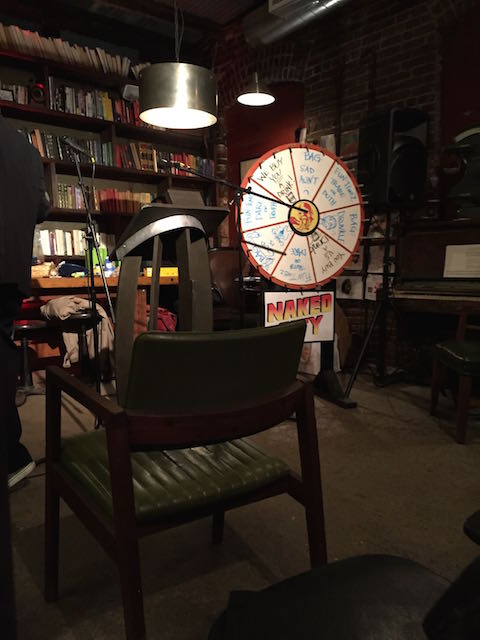
Naked City is something of a cross between an open mic and a game show.  People sign up to perform, they are called up at random and they are given five minutes to do whatever.  If they go over five minutes, they must spin The Wheel of Consequences, which can result in anything from free drinks (either for you on the hosts’ tab or for the hosts on your tab) to bags of booze and dollar store trinkets to being recruited for a short piece of performance art.

The Wheel of Consequences

The view from my seat

Each show has a theme.  The theme for this month was Courage.  I could have told a tale or two about the times I’ve shown courage in my life but instead I decided to do something courageous as a demonstration.  Instead of a written piece, I would do a performance of sorts–I would hand out my flowers to anyone who wanted them.

As I’ve noted elsewhere, I’ve been reasonably good at producing flowers but not so good as distributing them.  Approaching people to offer them free art feels a little too much like salesmanship and I am not a salesman.  But I worked up my nerve to sign up and when my number was called I went up and explained what I was about to do.  I invited people to come up to the podium and receive a flower.

I wasn’t sure what to expect.  Or, rather, I had expectations, but they were contradictory ones.  My pessimistic self claimed that no one would come up at all.  My cautious self suggested a few would.  My optimistic self predicted that lots of people would come and that they would be happy to receive the flowers.

My optimistic self won the bet.  People were on their feet, lining up in what one person called a more fun version of communion.  They were delighted and I was too.  It happened so swiftly that I didn’t even have to spin the Wheel of Consequences either.

As per usual when I face down a fear, I felt a surge of bliss as a result.  People thanked me for the flowers and congratulated me for my display of courage.

I still have hundreds to give away.  I’ll just have to keep being courageous.


Click here to learn more about The Ten Thousand Flowers Project.

Rich Living: I Am Not Paul McCartney

Be yourself; everyone else is already taken.

–Oscar Wilde

If I want to really feel insignificant, I just compare myself to Sir Paul McCartney.

Face it, the man has more money, fame and sheer and absolute coolness than I can ever dream of possessing.  My net worth is spare change next to his collected assets.  His impact on history is the Grand Canyon where mine is a little line scraped in the earth with a stick.  By the time he hit my age, he’d already transformed the landscape of popular music as a member of the Beatles and was still knocking out hit songs with a little band called Wings.  Me, I’ve got a few bright ideas and some blogs, and this weird art thing that I’m doing that some people tell me is pretty neat, but that most people don’t even know about.

But, you know, sitting around and feeling insignificant isn’t a hell of a lot of fun, so I try to avoid weighing my lifespan against that of Sir Paul.  Actually, it’s best not to weigh your life against any standards, even, strange as it may seem, your own.  That way lies a different kind of madness–the one where you constantly berate yourself for where you should be by now without taking any pleasure in where you are.  (I should be published by now.  I should be married by now.  I should have a house by now.)  Even comparisons between now and your past self can trap you in misery, because lives do not always progress on a neat upward slope.  I could look back at the time a few years ago when I had the stable job and the hot boyfriend and compare it to now where I have . . . neither.  Yeah, maybe not such a great idea.

It’s a mental trap that snares many a hardy soul.  So, how do you get out of it?  Start with the one thing you have that nobody else does.  Yourself.  You are the only you there will ever be on this earth.

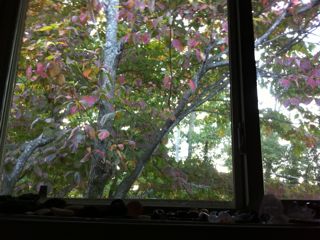
I’m typing this while I’m in front of a window that faces a dogwood tree.  The leaves are starting to tarnish into their fall colors.  Nobody else at this moment is able to see this.  Nobody else can–if somebody came in and looked over my shoulder, what they would see would not quite be the same.  Even as I try to clumsily describe it to you, what comes up in your mind will not be what I am seeing.  If I take a picture, it’s still not quite the same because you’re looking at it on a computer screen instead of as I am now.

view from desk

See what I mean?

Every moment of your life that you are aware of is a moment that you are a unique witness to.  No one, not even Sir Paul with all his millions, can buy it from you.  Artists do what they can to translate their points of view into tangible form, but even then they are doomed to fall short.

I have driven home on rainy nights with a Nick Drake song playing on the iPod hooked into my car stereo and it feels like I’m in the middle of the most beautifully shot art film.  Yet I’m the only one in the theater and I’m never going to see this scene again.

Step back from where you want to be and look at where you are.  Really look at it, because nobody else is able to, not in the way that you do.  Treasure it, savor it, embrace it and you will find that where you stand in comparison to others doesn’t matter.  They’ve got their lives to live; you have yours.  And nobody else is able to do the job of being you.  So make the most of it.

I may never be as cool as Sir Paul McCartney.  But I will always and forever be as cool as Sheila O’Shea.  And that’s all I really need to be.

Rich Living: How to Be Present

The starting point of living a rich life is to pay attention to it.  This seems ridiculously obvious, until you try doing it on a consistent basis and become more aware of how your brain can go rabbiting off from the present moment and gnawing on stupid things like What That Mean Person Said On The Internet.  Honing one’s ability to keep the mind on the moment is ultimately a lifetime process.

Think of it a bit like an exercise program.  There’s never really a point when you can say “Yay!  I’m fit now!” and never have to exercise again.  If you do, you’ll be okay for a while but eventually your body will regress for lack of challenges.  However, much like fitness, the more you do, the better you get at it to the point that a flight of stairs that would normally wipe you out completely can now be ascended two steps at a time.  (And I’m not exactly one to talk about keeping in shape, mind you; how do you think I know about what happens when you slack off?)

There are loads and loads of books and resources on mindfulness and presence, from The Miracle of Mindfulness by Thich Nhat Hanh (which I highly recommend) to The Power of Now by Eckhart Tolle (which likewise I did benefit from, though I did have some issues with.)  If that’s too woo for you, there are many nifty scientific studies on the benefits of mindfulness.

Does this mean you can’t ever let your mind wander ever?  Of course not.  But presence allows you to notice when your mind is wandering and bring it back to the moment.  You can even set your mind loose and decide “I’m going to just sit and think for a while.”  (This is one of the reasons I carry a catbook–so I can allow my mind to ramble and still remain in the present moment as I focus on the pen on the page getting all my thoughts down.)

But what if the present moment is kinda sucky?  Wouldn’t it be better to vanish into the mental clouds for a while until the moment passes?

Here’s the thing.  A rich life is not a pain-free life, nor a perpetually happy life.  A rich life has moments of agony as well as bliss, grief as well as elation, loss as well as gain.  That is how life works.  You have to be there for all of it.  But you will notice that if you accept the pain and honor the pain, it will pass more quickly than if you try to smother it.  Pain is a signal from the body that something is wrong that needs to be set right.  By paying attention to it, you can determine its source and have a clearer idea of what to do about it.  Emotional pain is much the same way.

An important part of presence is acceptance.  There are some things you can change.  If you’re in an uncomfortable position on the couch, you can shift and get more comfortable.  There are, however, some things that you can’t.  If you’re stuck in traffic, there’s really not much you can do except wait.  (Unless, I suppose, you want to be one of those people who thinks that the fact that they’re in a big hurry qualifies them for the emergency lane.)  While you wait, you can seethe about how horrible traffic is, or you can turn up the stereo, plug in some music you like and pay attention to that until traffic moves forward some more.  Your call.

Presence is the practice in which all other components of rich living are rooted.  By seeing what you are surrounded by, you are able to be grateful for it and to be curious about it.  And the best way to be yourself is to be who you are in this moment, without waiting for some better moment to arrive.

Rich Living: The Basics

One of the nifty things about having a blog with a nonsensical title is that you can veer madly in a different direction and nobody can seriously complain that the blog is no longer as advertised.

So far here I’ve talked about free writing techniques and my Word Art and now I feel like adding another category to the mix.  Because the 2,000+ words in True Wealth didn’t really cover all I had to say about my notions of how to live what I call a rich life.

You do not have to be a rich person to live a rich life.  Rich living is, in fact, entirely independent of how much money you have coming in or tucked away in the bank.  You can be down to your last dime and out on the streets and still live a rich life.  (In some ways, it might even be easier to.)  You don’t have to be dirt poor to live a rich life, either.  I’m not knocking money, it’s great stuff to have and I sure as hell could use some right now, but I’m not letting my current situation get in the way of living richly.

There are two kinds of poverty–the poverty of the material and the poverty of the soul.  There’s been a lot of noise going on about the former but talk of the latter is seen as something you can only worry about when you’ve gotten your material situation completely to your satisfaction.  Not just your basic needs covered, mind you, but the ideal job, the ideal income, the ideal location and no more worries ever.  Then, and only then, can you take your nose off of the grindstone and pay attention to your surroundings.  Until then, you have work to do, dammit, whether it’s the job you’re making your way through until retirement or the business you’re trying to launch, anticipating that indefinable sense of having arrived.

Right now, a lot of people are still thrashing in that state of uncertainty, waiting for something to happen, waiting for things to get better, waiting for the perfect arrangement of economic forces to restore a sense of security.  And in the meantime they condemn themselves to the worst kind of poverty, the poverty that in fact requires far less to be alleviated than people realize.

You do not have to wait until you can quit the sucky job and start your fabulous business to live a rich life.

You do not have to wait until you have enough cash in the bank.

You do not have to wait until you can afford to buy a place and stop renting.

You do not have to wait until you’ve found the love of your life.

You do not have to wait for the pain to go away.

You do not have to wait for anything.

Be present.

Be grateful.

Be curious.

Be yourself.

Those are all you need.  Right here, right now.

Start.