Word Art: Peering Through the Eye

At this point, I don’t have my artwork framed professionally but make use of standard photo frames from thrift shops and dollar stores.  Not only am I too broke to afford much more, I prefer to be able to remove the art easily in order to scan it or make minor corrections.

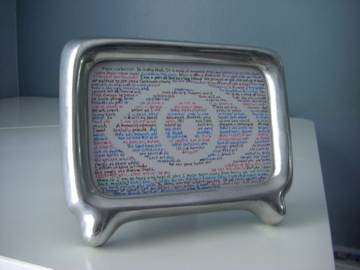
I picked up a frame on one of my thrift shop runs that resembled a television screen and made an earlier attempt to fill it with words that would look like static but I got bored with what I was doing about a third of the way through it and abandoned it.  I started again, this time coming up with an eye design in GIMP and tracing the printout.  I got about halfway through it and set it aside before finally finishing it up over a glass of bourbon at a brewpub within walking distance of my home.
Peering Through the Eye

Peering Through the Eye

There is a barrier.

It is this thick.

It is made of magazine pages and television screens, layer upon layer upon layer.

Something like glass.

What is seen is distorted.

You ripple when you move.

It makes you beautiful.

I am a part of the swirling crowd.

We struggle to get close enough to touch, or at least to see just a little more clearly.

You are surrounded from so many angles and each flat image provides an addition to a composite assembling in my mind.

I try to even take in the ugly moments, the pettiness, the flaws and fumblings.

They console me so, remind me that you are human, and I am given a sense of being close enough to see you vulnerable, even as I am not the only witness to such things.

It can still feel like a secret that has been shared just between the pair of us.

At times it can feel as if my broken up places are known just as clearly to you, in the ways you sing or speak.

These are only illusions.

And yet we crave them so.

I use the newspapered pages to patch up the cracks in my heart.

I weave your glamour into a net in order to hold myself in place.

It is a willing sort of bondage.

Indeed, you never even asked it of me.

And yet I am yours to call upon.

You ask so little of one who would give so much.

A moment’s attention would be such tiny payment in exchange for all that I would so gladly provide.

And yet there are many others who would do the same and all those tiny moments add up, become minutes, become hours, become days and you would have no time left to do anything at all.

And so those flickers of your regard become as precious and rare as jewels, cut to shine, treasured and worn as symbols of status.

We sometimes carve ourselves some kind of semiprecious substitute out of daydream and creativity.

(It is a harmless enough practice as long as one is not foolish to the point of delusion that they are the same as the genuine article.)

There are days when I dream of ascending to the ranks of those whose moments of attention are carved into jewels.

I dream of being surrounded by the same layers that surround you, the screens, the pages, the camera lenses.

I dream of being that much closer to you, close enough for you to see me clearly.

(And yet I know that if I am to have any hope of that I must turn away from facing you and turn to face myself.)

Until then, I settle for the fishbowl flickers when I get close enough to press my hand against the glass.

It seems warmer where you are.

Do you really see me when I stand so close?

Can you see me ripple when I move?

Am I, dare I hope, made beautiful?

The first seven lines had been composed in my head as the start of a poem and stayed in limbo for many years.  Writing them down as the start of this piece forced the issue.  I did a bit of notebook drafting for this one but, as always, the words tended to shift a bit between initial composition and execution.

Is it about anyone in particular?  It is, in a sense, about a lot of people, about the nature of celebrity obsession as I have experienced it and witnessed it.  I can’t imagine a better frame for it, really.

Prints of this work are available here.

The original is not for sale.
Where the Guide Dog Led Me

Sometimes people still ask me if Twitter is useful for anything.  I have to say it’s managed to keep me informed of many things, whether it’s finding out about a Henry Rollins gig at the last minute or pointing me to blog entries and news items that I would have otherwise known nothing about.

One day, @neilhimself retweeted an announcement by @neverwear for a contest requesting artistic depictions of Cabal the Dog.

“Hey,” I thought, “I happen to have an artistic depiction of Cabal the Dog handy.  I think I’ll send it in!”

And so I did and thought absolutely nothing of it beyond that.  And another fine day came along when Mr. Gaiman retweeted the announcement of the winners.

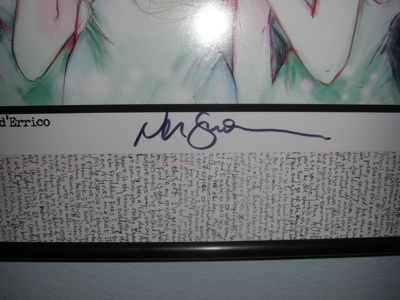
“Hm,” I thought, “I wonder who won that?  Surely it wasn’t me.”  So I tapped the link and read on my little iPhone screen and nearly dropped my phone in shock to see my scribbly little depiction was among the eight winners to be printed in a limited edition postcard set.  Then I read further and found out that I was also the winner of a print signed by Neil Gaiman.

Once I’d gotten to a proper computer, I posted a hello and expressed my amazement.  Then I had to figure out how to get a 300 dpi file out of the hasty snapshots of the work I’d taken before framing it and giving it away.  (Thankfully, I have a dad who knows his way around PhotoShop, and he was able to clean it up for me and make it presentable.)

The print arrived in my mailbox not long after and I knew if I waited until I had enough money to get it properly framed the thing would be sitting for months in a mailing tube, so I went and got it improperly framed instead.

The print itself measured 18″ by 12″ which, I quickly discovered, is not exactly a standard frame size.  I paced up and down the aisles of my local craft store and finally settled on a simple 14″ by 18″ frame.  All the way home, I pondered strategies for filling in the two inch gap, mentally going through my inventory of hoarded art supplies from my previous life as a picture framer and wondering what I’d still managed to hold onto over the past several moves.  I go through cycles of packrattery and purgation that are probably not helped by the fact that every once in a while something I still have stowed somewhere manages to come in handy.

Like, for example, a length of cash register tape that I’d scribbled the hell out of over the course of I’m not even sure how many days.  I’d found it recently while sorting through some boxes and I’d planned to photograph it and post it on this blog as a fascinating example of proto-word-art.  Instead I folded it to fit inside the frame and fill in the gap just under the signature.

Signed by Neil Gaiman

Actually Scribbled On By Neil Gaiman Himself

What do my words say?  I’m not entirely sure.  They weren’t intended as artwork, just a scrap paper head dump in lieu of a catbook.  But they filled the space nicely and they’ll work for now until I have enough money to pay a professional framer.

How to Talk to Girls at Parties

How to Talk to Girls at Parties

I’ll be sure to let people know as soon as the postcard set is available.  Or, at the very least, I’ll retweet about it.

Word Art: Uranus [Astronomy Series]

This planet is, of course, the one that makes schoolboys snicker upon the mere mention of the name.  The symbol only makes it worse, I fear–all you’d need to do is add a pair of hands and you’d practically have a pictogram for goatse.

Uranus

Uranus

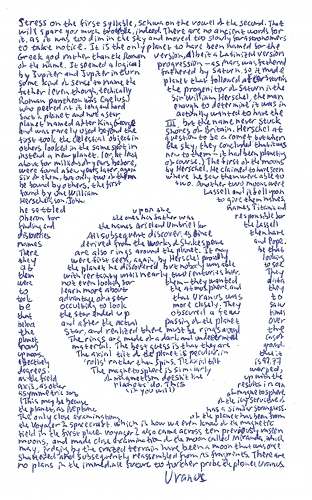
Stress on the first syllable, schwa on the vowel of the second. That will spare you much trouble, indeed.

There are no ancient words for it, as it was too dim in the sky and moved too slowly for astronomers to take notice.

It is the only planet to have been named for the Greek god rather than the Roman version, albeit a Latinized version of the name.

It seemed a logical progression–as Mars was fathered by Jupiter and Jupiter in turn fathered by Saturn, so it made some kind of sense to name the planet that followed after Saturn’s father (even though, technically the progenitor of Saturn in the Roman pantheon was Caelus.)

Sir William Herschel, the man who peered at it long and hard enough to determine it was in fact a planet and not a star, actually wanted to have the planet named after King George III, but the name never stuck and was rarely used beyond the shores of Britain.

Herschel at first took the celestial object in question to be a comet, but when others looked in the same spot in the sky, they concluded that it was instead a new planet.

(Or, at least, new to them–it had been planeting about for millions of years before, of course.)

The first of the moons were found a few years later, again by Herschel.

He claimed to have seen six of them, but only two of them where he saw them were able to be found by others, the first two.

Another two moons were found by one William Lassell and it fell upon Herschel’s son, John, to give them names.

He settled upon the names Titania and Oberon for the ones his father was responsible for finding and the names Ariel and Umbriel for the Lassell discoveries.

All subsequent discoveries since then have names derived from the works of Shakespeare and Pope.

There are also rings around the planet.

It may be that they were first seen, again, by Herschel proudly looking at the planet he discovered, but nobody was able to see them with certainty until nearly two centuries later.

They were not even looking for them–they wanted data to learn more about the atmosphere and they took advantage of a star that Uranus was to be occulting to look more closely.

They saw that the star ended up obscured a few times before and after the actual passing of the planet over the star, and realized that there must be rings around the planet.

The rings are made of a dark and undetermined (as of now) material.

The best guess is that they are ground up moons.

The axial tilt of the planet is peculiar, in that it effectively ‘rolls’ rather than spins.

The axial tilt is 97.77 degrees. The magnetosphere is similarly warped, as the field of magnetism doesn’t line up with the axis, as other planets do.

This results in an asymmetric sort (if you will) of magnetosphere.

(This may be because of the icy structure of the planet, as Neptune has a similar strangeness.)

The only close examinations of the planet has [sic] been from the Voyager 2 spacecraft, which is how we even know of the magnetic field in the first place.

Voyager 2 also came across ten previously unseen moons, and made close examination of the moon called Miranda, which may, judging by the crazed terrain have been a moon that was once shattered and subsequently reassembled from its fragments.

There are no plans in the immediate future to further probe the planet Uranus.

Yes, you’re absolutely right, I didn’t have to go there, but understand that this was after I’d just finished Jupiter and Saturn in a mad dash to finish the planets by the end of Thursday and I was eager to finish it so I could move on to Neptune and be done with it.  So I went for the dumb joke.  Sorry about that.

Prints of this work are available here.

The original is not for sale.

Word Art: Saturn [Astronomy Series]

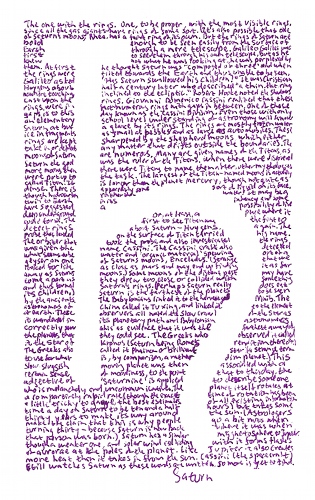
Last night I met someone–the new friend of an old friend–who had a symbol for Saturn worked into a tattoo on his arm.  It was, to my momentary bafflement, entirely unlike the symbol for Saturn that I’d traced and rendered into Word Art.  The symbol he’d chosen was one that dated back to Medieval times whereas the one I’d used had been swiped from the NASA website.  It struck me as an interesting object lesson in the mutability of symbols over time.

Saturn

Saturn

The one with the rings.

One, to be proper, with the most visible rings, since all the gas giants have rings of some sort.

(It’s also possible that one of Saturn’s moons, Rhea, has a faint ring of its own.)

But the rings of Saturn are bold enough to be seen easily from the surface of Earth through a mere telescope.

Galileo Galilei was first to see them through his own telescope, but as he knew now what he was looking at, he was perplexed by them.

At first he thought Saturn was “composed of three” and when the rings were tilted towards the Earth and thus unable to be seen, Galileo asked “Has Saturn swallowed his children?”

It was Christian Huygens, about half a century later who described “a thin, flat ring, nowhere touching, inclined to the ecliptic.”

Robert Hooke noted the shadows cast upon the rings.

Giovanni Domenico Cassini realized that these rings were in fact numerous rings with gaps in between.

One of these gaps is to this day known as the Cassini Division.

Even those with only an elementary school level understanding of astronomy will know Saturn at but a glance by its rings.

The rings are mostly frozen water ice in fragments as small as pebbles and as large as automobiles.

These rings are kept sharpened by the shepherd moons, which either take in or deflect any matter that drifts outside the boundaries.

The moons of Saturn are numerous. Many are given names of the Titans as Saturn the god was the ruler of the Titans.

When there were discovered more moons than there were Titans to name them after, other mythologies were put up to the task.

The largest of the Titan-named moons is actually called Titan. It is larger than the planet Mercury, though not quite as dense.

There is apparently some sort of liquid on its face, though hydrogen rather than water.

It may be a twin to Earth in its infancy and some have suggested a possibility of life deep underground.  Or, at least, a place where it could form.

The first to see Titan was the first to detect rings about Saturn–Huygens, again.

The probe that landed on the surface of Titan carried his name.

The orbiter that took the probe and also investigated the rings was given the name Cassini.

The Cassini craft also detected what seems to be water and ‘organic material’ spewing out of a geyser on one of Saturn’s moons, Enceladus.

(Strange that we looked for life as close as Mars and may end up finding it as far away as Saturn’s moons.)

Some moons of the distant past may have come apart as they drew too close or collided with something and thus formed Saturn’s rings.

(Perhaps Saturn really does eat its children.)

Saturn is the farthest of the planets to be seen by the ancients.

The Babylonians linked it to the harvest god Ninib.

The astronomers of China called it Tu Xing, and linked it to the element of earth.

These observers all noted the slow crawl of the star as it wandered on its planetary path and Babylonian astronomers correctly saw this as evidence that was the farthest away of the planets that they could see.

The Greeks also observed it, called it the star of Kronos (Saturn being Rome’s rendition thereof.)

The Greeks also called it Phainon or brilliant star (a strange term for what is, by comparison, a rather dim planet.)

This slow, sluggish moving planet was then associated with a certain sense of moodiness, to the point that to this day, the adjective of ‘saturnine’ is applied to describe someone who is melancholy and uncommunicative.

The planet itself rotates at a comparatively rapid rate (though the exact time of rotation as been a little tricky to gauge, the best estimates of all existing information time a day on Saturn to be ten and a half hours) but takes some thirty years to make its way around the sun.

(Astrologers make the claim that this is why people go a bit nuts when turning thirty–because Saturn is now back where it was when that person was born.)

Saturn has a similar magnetosphere to Jupiter, though a weaker one, and solar wind colliding with it forms flashes of aurorae at the poles of the planet.

Like Jupiter it also creates more heat than it takes from the Sun.

Cassini (the spacecraft) still watches Saturn as these words are written, so more is yet to find.

Since I’d done the planets in order starting from Mercury and working my way out to Neptune, I found myself occasionally referring back to previous planets as I progressed.  Since much of the words around Mars centered on the possibilities of life there I couldn’t resist making note that there are apparently better chances of life in the vicinity of Saturn according to current research.

Prints of this work are available here.

The original is not for sale.
Word Art: Jupiter [Astronomy Series]

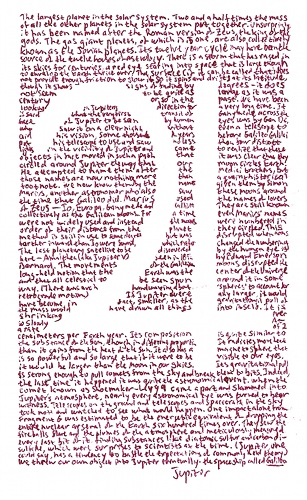
Jupiter was the first planetary symbol that, blessedly, didn’t saddle me with the tricky business of filling in words around a circle.  It’s also not a symbol that has too many pop-cultural associations, so people either know what it is on sight or have no idea whatsoever.

I started it on Thursday morning, the day before I was supposed to take the work to Chattacon.  Procrastination had once again backed me into a corner and I prayed to make it at least as far as Saturn by the end of the day.  (Fortunately, I made it all the way to Neptune.)

Jupiter

Jupiter

The largest planet in the solar system.

Two and a half times the mass of all the other planets in the solar system put together.

Unsurprisingly, it has been named after the Roman version of Zeus, the king of the gods.

The gas giant planets, of which this is one, are also collectively known as the Jovian planets.

Its twelve year cycle may be been the source of the twelve houses of astrology.

There is a storm that has raged in its skies for centuries, a red eye staring into space that is large enough to envelop the Earth thrice over.

The surface (if it can be called that) does not provide enough friction to slow it, so it spins and drifts at its latitude, though it shows signs of fading by degrees–it does not seem to be quite as large as it was a century or so in the past.

We have been looking in Jupiter’s direction for a very long time.

It is said that the very first transit of Ganymede across the face of Jupiter to be seen by human eyes was by Gan De, who saw it on a clear night without even a telescope to aid his vision, some thousands of years before Galileo Galilei put his telescope to use and saw no less than four distinct lights in the vicinity of Jupiter and came to realize that these objects in fact moved in such a path that it was clear that they circled around Jupiter the way that our moon circles Earth.

He attempted to name them after the Medici brothers, but those names are now nothing more than a quaint historical footnote.

We now know them by the name given them by Simon Marius, another astronomer who also saw these moons around the time that Galileo did.

Marius used the names of lovers of Zeus–Io, Europa, Ganymede and Callisto.

They are still known collectively as the Galilean moons.

For a time even Marius’ names were not widely used and instead the moons were numbered in order of their distance from the planet they circled.

This method is still in use to some degree but was disrupted when moons farther inward than Io were found, which rather changed the numbering.

The last planetary satellite to be discovered by the human eye is here–Amalthea (aka Jupiter V) seen in 1892 by Edward Emerson Barnard.

The movements of the Galileian moons disrupted the long-held notion that the Earth was the center of the Universe and that all celestial to be seen spun around it in some way.

(There was much handwaving about ‘spheres’ to account for retrograde motion.)

If Jupiter were any larger, it would have become, in fact, smaller, as the gravitational pull of the mass would have drawn all things into itself.

It is shrinking ever so slowly. At a rate of 2 centimeters per Earth year.

Its composition is quite similar to the substance of the Sun, though in different proportion.

It radiates more heat than it gains from the heat of the Sun.

It also has a magnetosphere that is so powerful and so large that if it were to be visible to our eyes, it would be larger than the Moon in our skies.

Its gravitational pull is strong enough to pull comets from the sky and break them to bits.

Indeed, the last time it happened it was quite the astronomical event.

When the comet known as Shoemaker-Levy 9 came apart and slammed into Jupiter’s atmosphere, nearly every astronomical eye was turned to bear witness.

Telescopes on the ground and telescopes and spacecraft in the sky took note and watched to see what would happen.

One impact alone from Fragment G was estimated to be the energetic equivalent of dropping the entire nuclear arsenal of the Earth six hundred times over.

They saw the fireballs flare and the plumes of the atmosphere and meticulously measured every last bit of it, finding substances like diatomic sulfur and carbon disulfite, which were surprises to scientists at the time.

(Jupiter, one could say, has a tendency to baffle the expectations of commonly held theory.)

We threw our own object into Jupiter eventually–the spaceship called Galileo.

Again, facts were written in roughly in order of what looked interesting, from historical discoveries to the red eye storm to the sheer delightful geekery of Comet Shoemaker-Levy 9 and those who watched to see it collide with the planet.  By this point, I’d gotten better at figuring out roughly how much information to gather in advance in order to fill the 3-inch-by-5-inch spaces designated for the text, which sped the process up considerably.

Prints of this work are available here.

The original is not for sale.
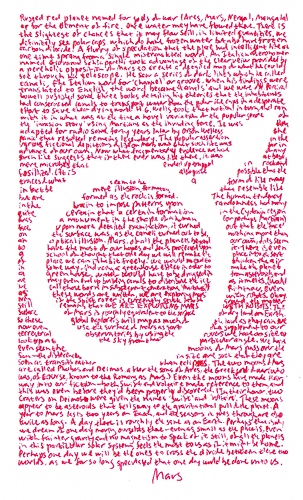
Word Art: Mars [Astronomy Series]

I am not a scientist and have no immediate plans to become one, so when gathering the information to fill in the spaces on the planetary series I’m more interested in the cultural implications of the planets than I am in the statistics of the bodies themselves.  Mars is a good example of this.

Mars

Mars

Rusted red planet named for gods of war (Ares, Mars, Nergal, Mangala) or for the element of fire.

Once water may have flowed there. There is the slightest of chances that it may flow still, in limited quantities.

We definitely see polar caps, which do have frozen water but also have frozen carbon dioxide.

A flurry of speculation that the place had intelligent life at one time sprang from a single mistranslated word.

An Italian astronomer named Giovanni Schiaparelli took advantage of the clear view provided by a perehelic opposition of Mars to create a detailed map of what he could see through his telescope.

He saw a series of dark lines which he called canali, the Italian word for ‘channel’ or groove.

When his findings were translated to English, the word became ‘canals’ and we were off.

Percival Lowell published some three books detailing his theories that the inhabitants had constructed canals to transport water from the polar ice caps in a desperate effort to save their dying world.

H. G. Wells took that notion in turn, and ran with it in what was at the time a novel variation of the popular genre of the ‘invasion story’ using Martians as the invading force.

It was then adapted for radio some forty years later by Orson Welles; the panic that resulted remains legendary.

The popular assertion in the various fictional depictions of life on Mars was that such life was far in advance of our own.

Now what fragmentary evidence we have of any such life suggests that if were ever was life there, it was at best mere microbes that ended up trapped in rock and fosillized. [sic]

It is also quite possible that the traces of what seem to be a form of life may in fact be mere illusion, formations that resemble life but are formed as the rock is formed.

The human tendency in the brain to impose patterns upon randomness had many quite certain that a certain formation in the Cydonian region was a monument in the shape of a human (or perhaps Martian) face.

Upon more detailed examination, it turned out that the ‘face’ on the surface as, as the canali turned out to be, nothing more than an optical illusion.

Mars, of all the planets beyond our own, does seem to have the most of our hopes and fears projected upon it.

There is even a school of thought that one day we will remake the place into the sort of place we can inhabit freely.

We would need to thicken the air in some way, inducing a greenhouse effect in order to make the planet a greenhouse.

Water would have to be dragged in from asteroids and we may even end up building canals to distribute the ice as it melts.

(Would we call those born in subsequent generations ‘Martians’?)

Right now, even as these words are written, we are exploring Mars with robots.

Okay, even if the Spirit rover is currently stuck in soft ground, the matter still remains that WE ARE EXPLORING MARS WITH ROBOTS!

The surface of Mars is roughly equivalent to the surface of dry land on Earth, so these global explorers will map as much of the land as they can.

We now even use the surface of Mars as sort of a supplement to our terrestrial observatories by using the rovers we have on site to look up at the sky from that particular angle.

We have even seen the moons of Mars pass over the sun–the differences in size are such that they are seen as transits rather than eclipses.

The two moons of Mars are called Phobos and Deimos, after the sons of Ares, the Greek god of war (who was, of course, known to the Romans as Mars.)

Even the moons have made their way into our fiction–both Swift and Voltaire made reference to them, and this was even before they’d been properly discovered.

(In their honor, two craters on Deimos were given the names ‘Swift’ and ‘Voltaire’.)

These moons appear to be asteroids that fell sway to the gravitational pull of the planet.

A year to Mars lasts two years on Earth, and the seasons it goes through are also twice as long.

A day there is roughly the same on Earth.

Perhaps that is why we dream of one day moving ourselves there–even as small as the place is, even with fainter gravity and no magnetism to speak of it still, of all the planets in this particular solar system, feels the most to us as if it might be home.

Perhaps one day we will be the ones to cross the divide between these two worlds, as we far so long speculated that one day would be done unto us.

The trickiest part was coming up with turns of phrase that would allow for very short words just where the edge of the image met the edge of the circle.  I seem to have managed.  And, yes, I did shift a bit in tone when I went all enthusiastic about the whole Exploring Mars With Robots thing but what can I say?  It still blows my mind that I can say that out loud and be telling the truth.

Prints of this work are available here.

The original is not for sale.
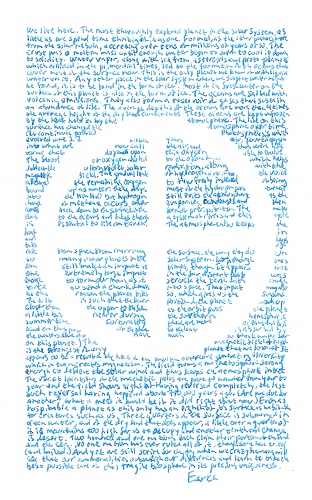
Word Art: Earth [Astronomy Series]

We don’t spend much time thinking about Earth being as much an astronomical body as any other planet in space, and I said as much in the text.  This one was both easier and harder than the other planets because of that.

Earth

Earth

We live here.

The most thoroughly explored planet in the Solar System, as little as we spend time thinking of it as one.

Formed, as the other planets were, from the solar nebula, accreting over tens of millions of years or so.

The crust was a molten mass until enough water begin to form to cool it down to solidity.

Water vapor, along with ice from asteroids and proto-planets which collided in the primordial times, led to the formation of the oceans that cover most of the surface now.

This is the only planet we know of with liquid water on it.

Any other place in the solar system where we suspect water might be found, it is to be found in the form of ice.

Most of the fresh water on the surface of this planet is also in the form of ice.

The oceans are salted with volcanic emissions.

They also form a reservoir of gases that sustain an abundance of life.

The average depths of the oceans are more than 4 times the average height of the dry land continents.

These oceans are kept unfrozen by the heat held in by the atmosphere.

The life on this surface has changed the atmosphere over time. (It continues to do so.)

Photosynthesis which evolved some 2.7 billion years ago, poured oxygen into what we now call the air, and thus were life forms that depend upon this oxygen able to evolve.

The flood of oxygen also led to the ozone layer which helps deflect the ultraviolet solar radiation, along with the magnetic field.

The gradual leak of hydrogen out into the void allowed the remaining oxygen to flow freely instead of being bound up as water.

These days most of the hydrogen gets turned into the H in H20, but hydrogen still exists in the atmosphere as the change of methane occurs.

Water evaporates, condenses and then comes back down to the surface in the form of precipitation.

The water flows to the oceans and lakes through a system of rivers and this cycle is essential to life on Earth.

The atmosphere also keeps the heat in and keeps bits of rock from space from marring the surface, the way they do on so many other planets in the solar system.

Large enough ones can still make an impact at times, though.

It appears that one extremely large impact in the far distant past was enough to form our Moon, as it struck the Earth with enough force to send a chunk of mass into space.

That impact may also be the reason this planet tilts so, which gives us the seasons.

The tilt is such that the lower portion of the planet winds up closer than the upper to the sun as the orbit puts the planet a little bit nearer during the southern hemespheric [sic] summertime.

Fortunately, there are more oceans and less land on that part of the planet so the heat is absorbed by the waters.

(We do have much to thank water for on this planet.)

The magnetic field of Earth is the strongest of any planet that we know of.

It appears to be a result of the heat of the molten outer core generating electricity which in turn creates magnetism.

The field forms a magnetosphere strong enough to deflect the solar wind and this keeps the atmosphere intact.

The exact locations of the magnetic poles are prone to wander from year to year and the field shows signs of having reversed completely, the last such reversal having happened about 780,000 years ago.

(Are we due for another? What a mess it would be if it did right about now.)

Even as hospitable a planet as this only has an eighth of its surface as habitable for creatures such as us.

Three quarters of the surface is submerged in ocean water, and of the dry land that does appear, a little over a quarter of it is mountains too high for us to occupy and another tenth and change is desert.

Two hundred and one nations each claim their portion of the land and the sea.

No one nation has ever ruled all of it, though some have tried (and failed.)

And yet we still strive for the day when we crazy humans will see that our commonalities outweigh our differences and learn to take the best possible care of this fragile biosphere in its precious uniqueness.

I could do it in no other color than blue.  It is the only planet I did in blue, understandably.  Alas, my Nice Light Blue Pen got lost in a bar somewhere when I was working out in the world and I had to use an imperfect substitute for this piece.  It seemed to have sufficed.

Prints of this work are available here.

The original is not for sale.
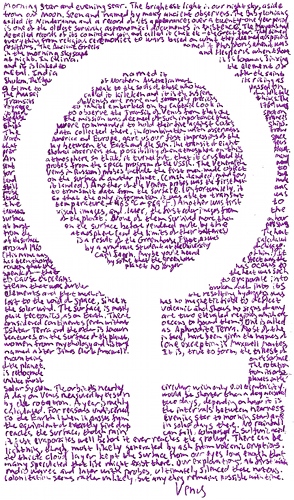
Word Art: Venus [Astronomy Series]

This one, of course, confuses from a distance because the symbol for the planet Venus is also the common symbol for “female.”  It probably didn’t help that I used the purple ink for this one–though I could have gone the distance and made the thing pink.

Venus

Venus

Morning star and evening star.

The brightest night in our night sky, aside from our Moon.

Seen and named by many ancient observers.

The Babylonians called it Nindaranna and a record of its appearances over a twenty-one year period is one of the oldest surviving astronomical documents in existence.

The Mayans had detailed records of its coming and going and called it Chak-ek–the Great Star.

They timed everything from religious ceremonies to wars based on what they deemed auspicious positions.

The Ancient Greeks named it Phosphorus when it was in the morning skyscape and Hesperus when it shone at night.

In China, it is known as Jinxing and it is linked to the element of metal.

India named it after the saint Shukra.

The Yolgnu of Northern Australia mark its rising as a time to speak to the souls of those who have passed on.

The Maasai called it Kileken and it is the subject of a folk tale.

Transits of Venus are rare and strangely precious things.

The voyage to Tahiti embarked on by Captain Cook in 1769 was in part to observe the Transit of Venus from that one spot on the globe.

The mission was deemed of such importance that France’s ships were commanded to hold their fire against Cook’s ships.

The data collected there, in combination with observations from North America and Europe, gave us our first impressions of the space that lay between Earth and the Sun.

The transit of eight years prior showed observers the possibility of an atmosphere on this planet.

An atmosphere so thick, it turned out, that it crushed the many sent probes from the space program of the USSR.

The Venera (the word for Venus in Russian) probes include the first man-made object to land on the surface of another planet.

(Crash-landed, mind you, but still it landed.)

Another of the Venera probes was the first man-made probe to transmit data from the surface.

(Unfortunately, it was stuck so that the only information it was able to transmit was the temperature–65° C or 869° F.)

Another was first to transmit visual images and, later, the first color images from the surface of the planet.

None of them survived more than an hour at most on the surface before rendered mute by the pressures from the atmosphere (and the limits of their batteries.)

The heat of the surface is a result of the Greenhouse Effect as was calculated around 1960 by a graduate student at the University of Chicago.

(His name was Carl Sagan.  Maybe you’ve heard of him?)

It has been thought by some that the greenhouse effect was the reason that the planet no longer has oceans to speak of–that the heat was such to cause the oceans to evaporate into steam that was further broken down into its elements and that much of the resulting hydrogen was lost to the void of space, since it has no magnetic field to deflect the solar wind.

The surface is mostly volcanic and shows no signs of any plate tectonics, as on Earth.

There are two elevated regions which are considered continents (even without oceans to bound them.)

One is called Ishtar Terra and the other is known as Andromeda Terra.

Most of the features on the surface of the planet, in fact, have been given the names of women from mythology and history.

(One exception is Maxwell Montes, named after James Clark Maxwell.  It is, true to form, the tallest of mountains on the surface of the planet.)

The rotation is retrograde from its orbit, unlike most planets in the Solar System.

The orbit is nearly circular, with only 0.01 eccentricity.

A day on Venus measured by the sun would be shorter than a day measured by the rotation.

A year is roughly two days, depending on how it is calculated.

For reasons undiscerned, the intervals between nearness to the Earth (when it passes from evening star to morning star) are the equivalent of exactly five days in solar days there.

No rainfall reaches the surface, though rain can fall, composed of sulfuric acid, it just evaporates well before it ever reaches the ground.

There can be lightning, though, most likely generated by ash from volcanic eruptions.

The thick cloud layer kept the surface from our eyes long enough that many speculated that life might exist there.

Our explorations, at first with radio waves and later with probes, ultimately silenced those notions.

Colonization seems rather unlikely, but anything remains possible with time.

Did I mention that Wikipedia was my friend?  The mention of the Venera probes linked to a detailed entry that listed every mission in the program, when it was launched, how long the probe survived and more.  I generally picked out the facts and information in order of what was interesting to me and got better at sifting through things as I progressed further out into the solar system.  The results would be lousy as an elementary school science report, but they work well enough as the background for this particular illustration.

Prints of this work are available here.

The original is not for sale.
Word Art: Icarus Speaks of His Fall From the Heavens

I’m doing this all wrong, aren’t I?  I should have worked my way through the Astronomy Series, maybe even a planet a day and then gone on to the rest of my art box.  But instead I go off and get all excited about this one piece I just finished yesterday and decide to do a blog post about that instead.

This was an idea I had bapping around in my head for a rather long time but had never got around to actually writing down until I decided to render it in Word Art form.  (This happens a lot to ideas I have–they seem to not come into their own until I find the right ‘container’ for them.  A couple of short story ideas of mine eventually blossomed into novels, for example.)  I’m probably not the first to have suggested that Icarus flew too close to the sun not out of ignorance, but as a deliberate choice.

Icarus Speaks of His Fall From the Heavens

Icarus Speaks of His Fall From the Heavens

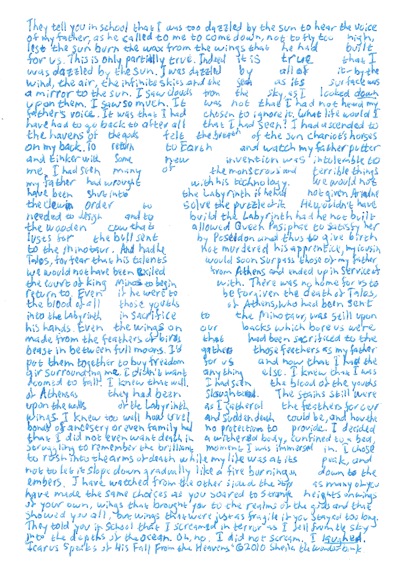
They tell you in school that I was too dazzled by the sun to hear the voice of my father, as he called me to come down, not to fly too high, lest the sun burn the wax from the wings that he had built for us.

This is only partially true.

Indeed it is true that I was dazzled by the sun.

I was dazzled by all of it–by the wind, the air, the infinite skies and the sea as its surface was a mirror to the sun.

I saw clouds from the sky as I looked down upon them.

I saw so much.

It was not that I had not heard my father’s voice.

It was that I had chosen to ignore it.

What life would I have had to go back to after all that I had seen?

I had ascended to the havens of the gods, felt the breath of the sun chariot’s horses on my back.

To return to Earth and watch my father putter and tinker with some new invention was intolerable to me.

I had seen so many of the monstrous and terrible things my father had wrought with his technology.

We would not have been shut into the Labyrinth if he had not given Ariadne the clew in order to solve the puzzle of it.

He wouldn’t have needed to design and to build the Labyrinth had he not built the wooden cow that allowed Queen Pasiphae to satisfy her lusts for the bull sent by Poseidon and thus to give birth to the Minotaur.

And had he not murdered his apprentice, my cousin Talos, for fear that his talents would soon surpass those of my father, we would not have been exiled from Athens and ended up in service of the court of King Minos to begin with.

There was no home for us to return to.

Even if he were to be forgiven the death of Talos, the blood of all those youths of Athens, who had been sent into the Labyrinth in sacrifice to the Minotaur, was still upon his hands.

Even the wings on our backs which bore us were made from the feathers of birds that had been sacrificed to the beast in between full moons.

I’d gather those feathers as my father put them together to buy freedom for us and now that I had the air surrounding me, I didn’t want anything else.

I knew that I was doomed to fall.

I knew that well.

I had seen the blood of the youths of Athens as they had been slaughtered.

The stains still were upon the walls of the Labyrinth as I gathered the feathers for our wings.

I knew too well how cruel and sudden death could be, and how the bonds of ancestry or even family had no protection to provide.

I decided that I did not even want death in a withered body, confined to a bed, struggling to remember the brilliant moment I was immersed in.

I chose to rush into the arms of death while my life was at its peak, and not to let it slope down gradually like a fire burning on down to the embers.

I have watched from the other side of the Styx as many of you have made the same choices as you soared to strange heights on wings of your own, wings that brought you to the realms of the gods and showed you all, but wings that were just as fragile if you stayed too long.

They told you in school that I screamed in terror as I fell from the sky into the depths of the ocean.

Oh, no.  I did not scream.  I laughed.

Before you congratulate me on my knowledge of Greek myth, I should clarify that I myself knew only the basics of the story of Daedelus and Icarus until the Internet was kind enough to tell me the rest.  I am particularly indebted to the University of Virginia Library for hosting a translation of Ovid’s Metamorphoses that provided an index and hyperlinks.  Those details alone were enough to take up most of the allotted space and the comparisons between the flight of Icarus and of those who seek a different way to fly were reduced to an afterthought, which I’m actually quite fine with.  This was, I think, the first Word Art piece I’ve done where I did the radical idea of drafting the words out first before committing them to artwork.  There were, obviously, some shifts between the draft and the final, as the right word or turn of phrase would need to be shortened or lengthened to fit the space.  It also allowed me to cut lines that I decided didn’t quite fit before I’d permanently committed to them.

The image is a very sloppy homage to Henri Matisse.  Doing an exact copy of his own Icarus would have been pushing it, I think.  My first attempt had the ‘feathers’ drawn too narrowly to be distinct from the usual spaces between words so I set it aside and began anew about an inch and a half into it.  It definitely gave me some more insights into what works and what doesn’t in terms of words and white space.

Prints of this work are available here.

The original is not for sale.
Word Art: Mercury [Astronomy Series]

About a month into my art career, I got it in my head that I would enter the art show at Chattacon, a little science fiction convention that I normally go to each year.  I downloaded and read the rules and realized that I’d need something to fit the proper themes of the show.

“I know!” I said to myself, “I’ll do a Word Art piece for each of the planetary symbols!”

Never was the timeworn phrase “easier said than done” more appropriate.  Granted, it did simplify things enormously–I wasn’t forced to rack my brain to come up with ideas and the titles were already in place before I even embarked on writing the words.  (Normally, titles come at the end rather than the beginning, which can make things tricky at times.)  The wonders of Google image search found me a picture of the planetary symbols from a NASA website and a little tinkering with GIMP rendered them the appropriate size so I could trace them to fit the 3″ x 5″ spaces I’d marked out on 5″ x 7″ sheets of paper to fit in a matching set of dollar store frames.

Then I had to actually write the words.  I checked a book out of the library to work from, because I wanted the solidity of paper reference, though I gathered the bulk of the information from the wonders of Wikipedia.  This is far safer than it may seem, since the Internet is not lacking for people passionate about science who will eagerly fact-check and verify nearly every line of such entries.  (As someone wryly observed, the thing about Wikipedia is that it works well in practice but it’s a disaster in theory.)

I wanted the words to be factual, though they were still subject to the mad poetical filter that the words tend to go through when they run from my head to the page, and it is entirely possible that there are some scientific inaccuracies contained within.  As the series progressed, I got better at gathering the information that was of the most interest to me and putting it to use filling in the spaces to define the symbol on the page.

I started with Mercury.

Mercury

Mercury

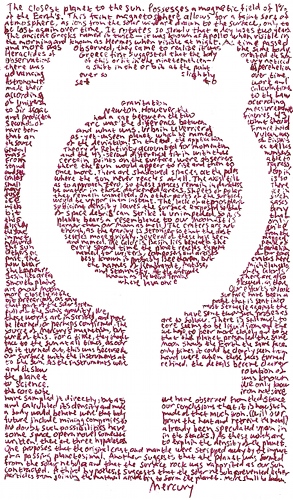
The closest planet to the sun. Possesses a magnetic field of 1% of the Earth’s.

This faint magnetosphere allows for a faint sort of atmosphere, as ions from the solar wind are drawn to the surface, only to be lost again over time.

It rotates so slowly that a day lasts two years.

The ancient Greeks named it twice–it was known as Apollo when visible in the morning and known as Hermes when visible at night.

As time passed and more was observed, they came to realize it was the same body.

Heraclides of Greece first suggested that the body orbited the sun.

Observations of this orbit in the nineteenth century noticed there was a shift in the orbit at the point of perehelion advancing ever so slightly over time.

Astronomers set to work and made their calculations according to the Law of Universal Gravitation according to Sir Isaac Newton.

However, the measurement and prediction had a gap between the two figures.

43 seconds of arc was the difference between what should have been and what was.

Urbain LeVerrier of France held that an as-yet-unseen planet, which he named Vulcan, was the source of the deviation.

In the end, the application of Einstein’s General Theory of Relativity accounted for momentum as well as mass and the 43-second difference fit in with those numbers.

From certain points on the surface, were observers able to stand there the sun would appear to rise and then to regress, and set once more.

There are shadowed spaces on the poles deep in craters where the sun never reaches at all.

The axial tilt is so small as to approach zero, so these spaces remain in darkness.

There may be water in those darkened areas, sheets of polar ice in place that remain unmelted.

On other parts of the surface, such ice would be vapor in an instant.

The lack of atmospheric gases with sufficient density leaves the surface exposed so that any bit of space debris can strike unimpeded.

So it is that this planet bears a resemblance to our Moon. (It is only slightly larger than our Moon as well.)

The craters are not quite the same, though, as the gravity is stronger so that the dust from the impact settles more quickly.

Several of these have been mapped, measured and named.

The Caloris Basin lies beneath the peak of the sun every second time the planet reaches the point of perehelion.

Others are named for writers, composers and artists of our times past.

The best known is probably Beethoven, but craters here now bear the names of Rembrandt, Matisse, Michelangelo, Shakespeare and Stravinsky.

At the antipode of the Caloris Basin lies an area known as The Weird Terrain.

There are also smooth plains where lava once flowed, as there are on our Moon.

Our efforts to look more closely at the surface have been a bit precarious, as any probe that is sent into that part of the solar system must struggle against the pull of the Sun’s gravity.

We have sent two such probes as these words are inscribed, and more are to follow.

There is still much to be learned, or perhaps confirmed.

The core seems to be liquid iron and the source of Mercury’s magnetism, but we hope to peer more closely and to be sure of this.

For a time, they thought that the planet presented the same face to the sun at all times, as our Moon shows the Earth the same face.

As it turned out, this was because the only times it could be clearly seen from our surface with the instruments at hand were when those faces turned to the sun.

As the instruments were refined, the details became clearer and the slow rotation of the planet was known to science.

We only know the core to be iron not since we have sampled it directly, but as we have observed from the distance and calculated its density and made our conclusions that it is how such a body would behave were that body made of that much iron.

(Will our future include mining companies to brave the heat and retreive [sic] the metal? No doubt such possibilities have already been speculated upon in some space opera novel somewhere in the stacks.)

As these words are written, there are three hypotheses to explain the density of the planet.

One proposes that the original crust and mantle were stripped away by the impact of a passing planetesimal.

Another suggests that the planet was formed from the solar nebula and that the surface rock was vaporized as our Sun contracted.

A third hypothesis suggests that the solar nebula prevented lighter particles from joining the material accreting to form the planet.

More shall be known.

It didn’t sell.  None of them did, perhaps because originals generally don’t sell well at that particular art show (or so I was told as I was checking my work out at the end of the weekend.)  It’s also possible I priced it a bit too high–I’ve since dropped my pricing to five dollars per square inch, having been taught by this that ten per square inch may be asking a bit much for an as-yet-unproven artist.

I did get many positive responses, though, which was encouraging.  I’m considering doing a series of the astrological symbols at some point, though I’ll need to get twelve matching frames together for that, so it may take a while.

Prints of this work are available here.

The original is not for sale.