Word Art: Spiral

Spiral was the first prototype for my Word Art that I was willing to show to other people.  (I’d tried something a couple of months prior, but the result was such a hot mess I’m not showing it to anybody until I’ve established a solid enough body of work to render said hot mess into a fascinating historical document.)  I’d cut a sheet of 25% cotton paper to fit an 8 x 10 frame I’d found in a drawer (still wrapped in plastic–where did it come from and why did I buy it?) and traced some pencil lines to define a space within the space.  Then I took a couple of gel pens that I’d gotten as a birthday present from my goddaughter and worked my way around.
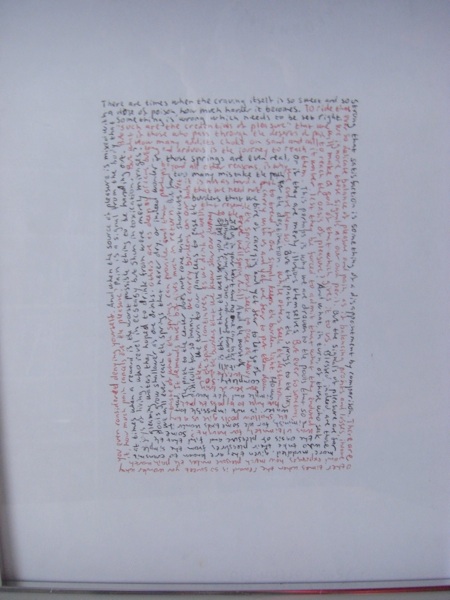
Spiral

There are times when the craving itself is so sweet and so strong that satisfaction is something of a disappointment by comparison.

There are other times when the reward is so sweet you wonder why you even considered denying yourself.

And when the source of pleasure is mixed with a dose of poison, how much harder it becomes.

To ride that ever so delicate balance of pleasure and pain, as if balancing profits and losses, income and expenses, how much pleasure makes the pain worth it, how much pain cancels out the pleasure?

Pain is a signal from the body that something is wrong which needs to be set right.

We ignore these signals at our own peril.

But the signals of pleasure are far more muddled, given they are known to transmit at times when a reward is the worst possible thing to be handing out.

But “such are the credentials of pleasure” that we will make a god of that which gives it to us.

Blessed, indeed, are those who take their pleasures from the simple joys of living, who revel in ecstasy but shun intoxication.

But what of those who pass through the deserts of pain to reach the oasis of pleasure?

And what, in turn, of those who seek the oasis of pleasure and find that the gleaming waters they hoped to drink from were merely mirages?

How many addicts choke on sand and call it water, lest they be forced to admit that what they endured was ultimately for naught?

Some pools grow shallower as one drinks.

Others are as deep as oceans, but long and arduous is the journey to reach them.

This perhaps is why we are drawn to the pools that so diminish, for we sometimes wonder if we will ever reach the springs that never dry, or indeed wonder if those springs are even real, or if they are merely illusions themselves.

But ever so sometimes, the shallow pools give us a tiny taste of what the springs can provide and that perhaps beyond all other reasons is why we crave them so.

But the path to the springs, to the living water, is not impossible to tread.

It demands much, but gives much in return.

But far too many mistake the path for the destination.

While others seek the destination but hope to bypass the path.

The path to the center does not come with shortcuts.

Yet it is not as hard a path to tread if one simply keeps the burden light.

How simple and yet how difficult for so many.

We carry burdens on our backs that we need not carry with us and yet we fear to put them down for fear of losing them.

We turn to our panaceas to ease the burdens that we tire of carrying and yet fear to let go of completely.

So the spiral continues, as we drink of wells that resemble the springs we truly seek to ease the heavy weight of the burdens that we know slow our journey to the true wellspring of all.

And the worst of it all is this–that the wellspring you seek can be dug in your heart and no one can take it from you once you have it yourself.

“Such are the credentials of pleasure” is a quote from the book Delusion’s Master by Tanith Lee, and a line I keep in mind when weighing the consequences of certain decisions.

I don’t know if I will ever do another piece like this, because the lines become a little difficult to keep track of after a certain point.  Even though I want the work to stand on its own visually, I also want those who are willing to try and read the words to be rewarded for their squinty efforts.

Prints of this work are available here.

The original is not for sale.
Word Art: Star Light Star Bright

This is the second of two recent “hey, look, I’ve got a picture frame, let’s fill it with art!” pieces.  (The previous entry, Fire Meets Water, was the other one.)  While it’s very, very, easy to get a standard size picture frame and do standard sized artwork to fit in advance, there’s something a little more fun about making art to fit into an existing frame, especially if the frame isn’t the usual photograph size.

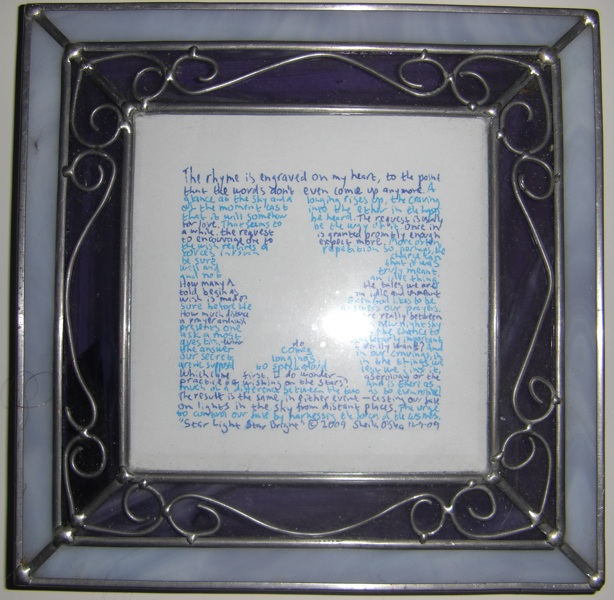
I’ve had this beautiful stained glass frame for so long I’m honestly a bit uncertain where I got it from.  I’m pretty sure it was a birthday present from a friend.  It sat, much like the bridesmaid’s gift frame, unfilled because I had no three-inch-by-three-inch pictures to fit into it and was reluctant to crop any existing photographs to make them fit.  When I finally started doing word art, one of the first things I wanted to try was a star as the white space.  This was the result:

Star Light Star Bright

Star Light Star Bright

The rhyme is engraved on my heart, to the point that the words don’t even come up anymore.

A glance at the sky and a longing rises up, the craving of the moment cast into the ether in the hopes that it will somehow be heard.

The request is usually for love. That seems to be the way of it.

Once in a while, the request is granted promptly enough to encourage one to expect more.

More often, the wish requires a repetition so, perhaps, the forces in such charge can be sure that it was well and truly meant, and not an idle thing.

How many of the tales we are told begin as an idle and unmeant wish is made?

Even God likes to be sure before He answers our prayers.

How much distance is there really between a prayer and a wish?

Each new night sky presents one with the chance to ask a most singularly important question. What do I really want?

And the answer comes in our cravings, in our secret longings, in the things we aren’t supposed to speak aloud lest we jinx it.

Which came first, I wonder–astrology or the practice of wishing on the stars?

And is there as much of a distance between the two as to even notice?

The result is the same in any event–casting our fate on lights in the sky from distant places.

The urge to control our fate by harnessing the forces of the cosmos.

Some of the turns of phrase came out a little weird because of the demands of fitting the words to the space provided.  I’m also not entirely happy with the way the first line was too large and too loose, but the rest of the words came out too well for me to want to toss the whole thing, so I’m keeping it.

Stars seem to have become a recurring theme in my work without much effort on my part.  There’s a piece I finished recently called “Moon, Stars, Comets and Other Possibilities” that runs in similar directions and I’m planning to do a series based on the astronomical symbols for the planets, followed by another series on the astrological signs.  Perhaps some future art historian can analyze the reasons why after I’m safely dead.  Until then, I’ll just be making the damn art.

Prints of this work are available here.

The original is not for sale.
Word Art: Fire Meets Water

If you told me to write a love song tonight, I’d have a lot of trouble.  But if you tell me to write a love song about a girl with a red dress who goes into a bar and is on her fifth martini and is falling off her chair, that’s a lot easier, and it makes me free to say anything I want.

–Stephen Sondheim

Despite the constant blather one hears about “thinking outside the box”, I find that creativity can be more effective when executed within boundaries.  Sometimes the limitations are a function of the medium, other times the limitations are self-imposed to catalyze the all important question “If I can’t do this, what can I do?”

Poetry is a good example of this.  Any poetic form, from a haiku to a limerick to a sonnet to a sestina, places limits on the words you can use, whether the syllables, the rhythm, the rhyme or even words or lines that must be repeated at specific points.  Those rules force you to narrow your choices, to pick the word or the line that will fit the form and carry your intended message at the same time.  And yet within those limits, the possibilities remain endless.

I go back and forth on whether the textual portion of my Word Art would be considered poetry or not.  I suppose with the rules of poetry having been slackened to include just about anything made out of words, I could call it poetry and no one would be in a position to contradict me.  But I still don’t feel quite comfortable with the notion, since the words aren’t worked out in advance and once they’re written, there’s no room for revision.  First draft poems, at best, then.

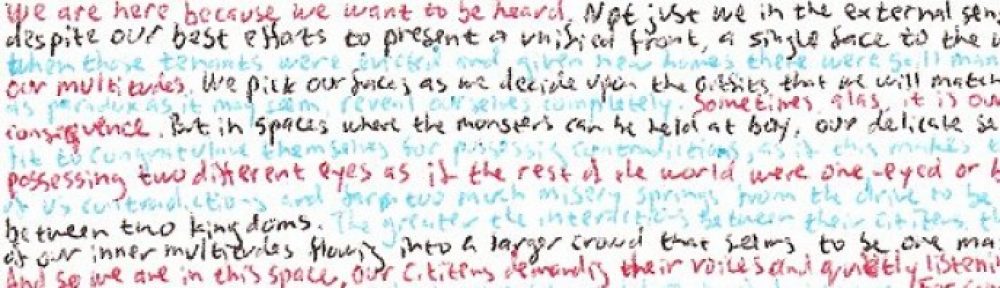
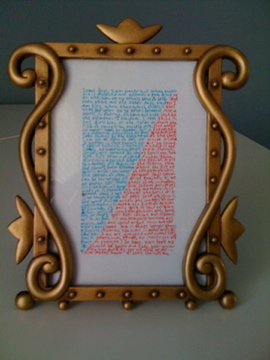
The particular rules for this poetic form, if you want to call it that, are still being worked out.  This piece was an experiment to determine how it would look visually if I used a boundary instead of the end of a sentence to change ink colors, as I’d done in other pieces up to that point.  I picked two distinct colors–blue and red–traced a slight curve to split the space and with some vague notions in my head about water and fire, I sat down and began to write:

Some days, I am water and what enters me is dissolved and becomes a part of my me, an addition to my overall sense of self.

And then there are the other days, the days I am fire, when that which enters is fuel to be fed upon, to be transformed in a source of energy, of heat and light.

Unlike the elements I emulate, I can shift in one direction or the other without the risk of cancelling [sic] myself out.

Fire added to water leads to steam.

Air is supposedly my element according to those who measure such things by the alignments of the stars. I am not sure of this.

Or maybe it’s true if steam is close enough to air to count.

I spend enough time with my head in the clouds, to hear some people say it.

Though, clouds are formed by way of sunlight, not fire.

Fire from a distance, rather than directly applied.

Where the zenith of the sky meets the depths of the oceans, then the clouds form between.

Where the fire of action meets the water of contemplation, the steam of ideas is formed.

And steam can be harnessed to drive engines, as we all know. (Or, rather, those of us those of us in modern civilization all know.)

But steam only drives when it is channelled at the moment it is formed.

Once it has escaped, the force of it is no longer enough to push solid objects in the way.

And so when the waters of our contemplation meet the fires of action, hesitation is only going to lead to a fog.

Action without contemplation only burns out, or rages over everything and destroys all in its path.

To contemplate without any action, well, one could argue that water wears away stone, but it takes longer than a single human lifetime in order to do so.

(And even if we are granted additional lives, each transition tends to interrupt the chain of thought.)

So keep your fire as it should be kept and keep your water as deep and pure as you are able to do.

I’d originally designed it to fit into one of two lonely picture frames that had been sitting without pictures in them for years.  (My next entry will probably be about the piece I did to fill the other frame.)  This one had been a bridesmaid’s gift from my sister-in-law and I realize with some embarrassment that she and my older brother have been married for well over a decade now.

Fire Meets Water -- original frame

Fire Meets Water -- original frame

Not long after finally putting something in that frame (before then, it still held the thank-you note from my sister-in-law with the message STEP AWAY FROM THE ANIMAL PRINTS!) I realized that it would be the perfect size for one of the school pictures of my youngest niece.  I made the substitution and moved the work over to one of the frames I’d gotten from a thrift shop run where I’d bought as many frames as I could with a roll of quarters.

Fire Meets Water -- current frame

Fire Meets Water -- current frame

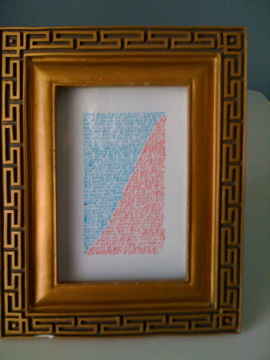
The frame is imperfect but suits it well.

Prints of this work are available here.

The original is not for sale.
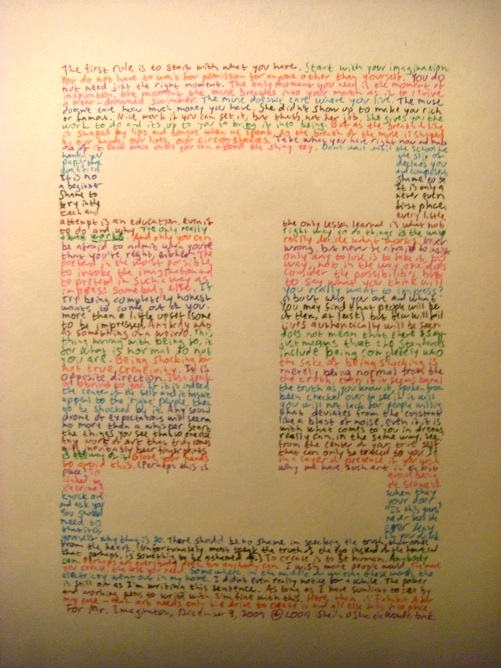
Word Art: For Mr. Imagination

I first met Mr. Imagination in front of a now-defunct punk club called 513 which, I murkily recall, was having some kind of all-day event on a pleasant Saturday afternoon.  I don’t remember much about the event, but I do remember Mr. I.  He wore a vest that was completely covered with bottlecaps that we all tried on at some point–it was a magical thing, clothing as percussion instrument that made a shooka-shooka noise as one danced.  He was a friend of my friend Lake–they went back quite a ways, apparently–and Lake’s living room had a number of his pieces on the wall.  When I saw the installation of his at the House of Blues in Las Vegas, I recall my thoughts being along the lines of “Wow, I feel like I’m at Lake’s.”

The party where my art career started was actually a joint celebration by Lake and Mr. Imagination.  Mr. I had recently bought a house not far from Lake’s place and partway through the festivities some of us walked over there in the chill December night to have a look at what he’d done to the place.  The walls were already covered with art and this was only a week after Lake’s husband had hung up the drapes for him.

That night, Mr. I paid me two tremendous compliments.  One was that he’d never seen anything like what I’d done.  The other was that he wanted to trade art with me.  My first official commission.  I set to it not long after.

I picked up a frame from the same Goodwill run that I picked up the frame for Guide Dog.  It was actually a bit of mass-produced framed art, a twee arty rendition of an elephant, but I took to the back of it with a flathead screwdriver and got rid of that nonsense.  (I made my living as a picture framer in my younger bohemian days, so I know my way around a frame and mat in a pinch.)  I cut the paper, drew the lines and one fine afternoon got out the pens and did the piece in roughly one sitting.  The words were thus:

The first rule is to start with what you have.

Start with your imagination.

You do not have to wait for permission for anyone other than yourself.

You do not need just the right moment.

The only moment you need is the moment of inspiration, the moment the muse breathes into your mouth as if to revive a near-drowned swimmer.

The muse doesn’t care where you live.

The muse doesn’t care how much money you have.

She didn’t show up to make you rich or famous.

Nice work if you can get it, but that’s not her job.

She gives you the work to do and it’s up to you to bring it into being.

But as the breath of life is shaped by lips and tongue when we speak, so the breath of the muse is shaped by our hands, our lives, our circumstances.

Take what you have right now and make use of it.

Don’t wait until you can afford the shiny toy.

Don’t wait until the school has handed you the slip of paper that declares you qualified and competent.

It is no shame to be a beginner.

It is only a shame to never even try in the first place.

Each and every little attempt is an education, even if the only lesson learned is what not to do and why.

The only really right way to do things is the way that works. And only you can really decide what works.

Never be afraid to admit when you’re wrong, but never be afraid to insist that you’re right, either.

The only way to lose is to fake it, to pretend in the worst possible way, not in the way one does to invoke the imagination and consider the possibilities, but to pretend in such a way as to say what you think will impress somebody else.

If you really want to impress? Try being completely honest about who you are and what wants to come out of you.

You may find that people will be more than a little upset (some of them, at least) but few will fail to be impressed.

Anybody who lives authentically will be seen as something of a weirdo.

This does not mean that there is something wrong with being so, it just means that the standards for what is normal do not include being completely who you are.

Being shocking for the sake of being shocking is not true creativity. It is merely being normal from the opposite direction.

Just speak the truth, even if it seems banal or obvious to you.

If it is indeed the truth as you know it, spoken from the center of the self and it hasn’t been checked over to see if it will appeal to the ‘right’ people, then you will not lack for people willing to be shocked by it.

Any sound that deviates from the constant drone of expectations will seem like a blast of noise, even if it is no more than a whisper.

Start with what comes to you in dreams, the things you see that no one else really can, in the same way, see.

Any work of art that truly comes from the center of your true self will inevitably bear fingerprints that can only be traced to you.

It is the way of it.

Glove your hands in a layer of pretense if you wish to avoid this.

(Perhaps this is why we have such art in the first place? To avoid being linked to the scene of the crime?)

When they knock on your door and ask you “Is this yours?” you should never feel the need to ever deny that it is.

If you do, ask yourself why that is so.

There should be no shame in speaking the truth that comes from the heart.

(Unfortunately, most speak the truth of the ego instead of the heart and that, perhaps, is something to be ashamed of.)

To create is to be human.

Anybody can. Perhaps not everybody does, but anybody can.

I wish more people would.

The more you create, the less you need.

Somewhere in the middle of writing these words, the electricity went out in my home.

I didn’t even really notice for a while.

The power is still out as I’m writing this sentence.

As long as I have sunlight to see by and working pens to write with, I’m fine with this.

Here, then, is Exhibit A for my case–that art needs only the drive to create it and all else falls into place.

And, yes, the power did go out while I was working and I didn’t figure it out until I got up to refill my water glass or something and noticed all the digital clocks were blank.

I neglected to take a picture of it in its frame, but I did snap a quick picture of it out of the frame so I’d have a record to do the transcript from.  It came out a touch hazy, but was legible enough for me to work with.

For Mr. Imagination

I completed the piece before Guide Dog, but Neil Gaiman got his first since he was only in the area for a single day and my chance to present it was brief.  Mr. Imagination received his piece a few days later and was bowled over by it.  I read him the words and he hugged me and thanked me.  I still have yet to collect my payment but I know where Mr I. lives now, so it shouldn’t be too much trouble.  When I do, I may amend this post to display what was exchanged.

Prints of this work are not available.

The original has been given to Mr. Imagination (aka Gregory Warmack)

Word Art: Guide Dog

I’ve decided that this shall be the blog of record for my word art creations.  Each piece will get its own blog entry, where I detail the story (however short or long) of the piece’s creation, post the transcript of the words themselves and post a picture of the result.

Rather than do it chronologically, I’m starting with the two pieces that are no longer in my possession, since I no longer have the physical objects to help jog my memory.  Of those two, I’m starting with the one I presented to Mr. Neil Gaiman, since I don’t have the option of tapping on his door and asking for another look-see at the work, as I do with the other one.

Five days before the night I mark as the start of my art career, I’d picked up a bright orange ticket from Little Shop of Stories, a little bookshop in Decatur which had won the privilege of having Mr. Gaiman appear for a signing by throwing one of the best Halloween parties to celebrate The Graveyard Book.  The ticket granted admission to the talk and reading he would be giving at Agnes Scott College.

Somewhere between the 5th (when I discovered that people who are not me also find my artwork worth looking at) and the 14th (when the event was scheduled) I got it in my head that I would make some art for Mr. Gaiman and present it to him as a gift.  I picked out a suitable frame at the same trip to Goodwill that I picked up the frame for the piece for Mr. I and cut a sheet of paper to fit in it.

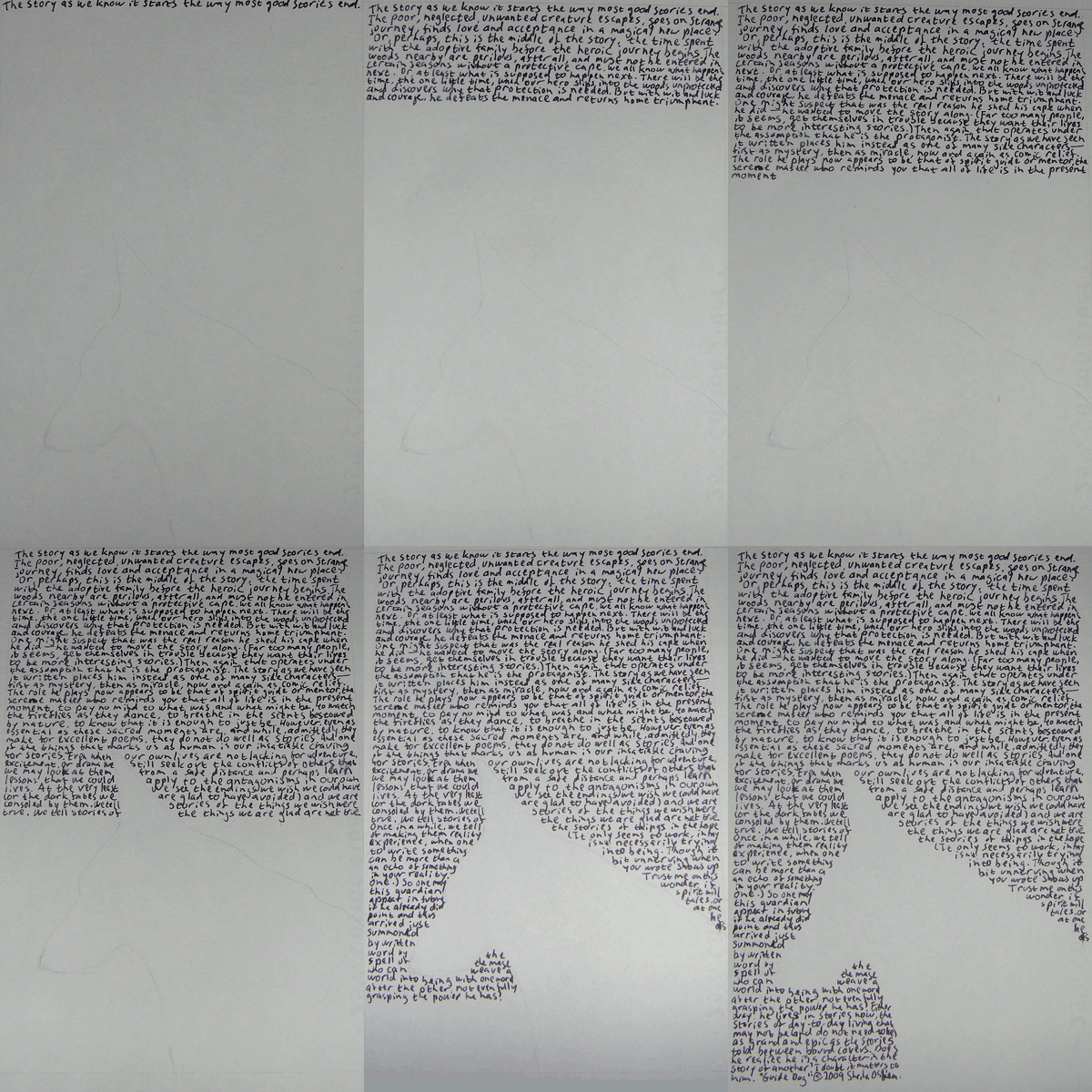
I swiped a photograph from Mr. Gaiman’s blog (seen here–it’s the second of the two) and sized it down to a suitable proportion.  The glass door to the patio served as an improvised light table as I traced (and re-traced, and re-re-traced) the outline of Cabal the dog to my satisfaction.

Thursday morning, after much dithering, I finally sat down and wrote the words.  Unlike all the other works so far, I used a Cross fountain pen and black ink instead of the gel pens I’ve been normally using.  It seemed appropriate.  The words ended up as follows:

The story as we know it starts the way most good stories end.

The poor, neglected, unwanted creature escapes, goes on strange journey, finds love and acceptance in a magical new place.

Or, perhaps, this is the middle of the story, the time spent with the adoptive family before the heroic journey begins.

The woods nearby are perilous, after all, and must not be entered in certain seasons without a protective cape.

We all know what happens next. Or, at least, what is supposed to happen next.

There will be the time, the one little time, when our hero slips into the woods unprotected and discovers why that protection is needed.

But with wit and luck and courage, he defeats the menace and returns home triumphant.

One might suspect that was the real reason he shed his cape when he did–he wanted to move the story along.

(Far too many people, it seems, get themselves in trouble because they want their lives to be more interesting stories.)

Then again, that operates under the assumption that he is the protagonist.

The story as we have seen it written places him instead as one of many side characters–first as mystery, then as miracle, now and again as comic relief.

The role he plays now appears to be that of spirit guide or mentor, the serene master who reminds you that all of life is in the present moment, to pay no mind to what was and what might be, to watch the fireflies as they dance, to breathe in the scents bestowed by nature, to know that it is enough to just be.

However, even as essential as these sacred moments are, and while, admittedly, they make for excellent poems, they do not do well as stories.

And one of the things that marks us as human is our insatiable craving for stories.

Even when our own lives are not lacking for adventure, excitement, or drama we still seek out the conflicts of others that we may look at them from a safe distance and perhaps learn lessons that we could apply to the antagonisms in our own lives.

At the very least, we see the endings we wish we could have (or the dark fates we are glad to have avoided) and we are consoled by them.

We tell stories of the things we wish were true.

We tell stories of the things we are glad are not true.

Once in a while, we tell the stories of things in the hope of making them reality.

(It only seems to work, in my experience, when one isn’t necessarily trying to write something into being. Though it can be more than a bit unnerving when an echo of something you wrote shows up in your reality. Trust me on this one.)

So one may wonder if this guardian spirit will appear in future tales or if he already did at one point and thus he arrived just as summoned by written word by the spell of the mage who can weave a world into being with one word after the other, not even fully grasping the power he has?

Either way, he lives in stories now, the stories of day-to-day living that may not be (and do not need to be) as grand and epic as the stories told between bound covers.

Does he realize he is a character in the story of another? I doubt it matters to him.

I took a photograph each time I hit a point of “Argh!  I don’t know what to do next!” and managed to turn the results into an animated GIF (with apologies in advance to those on dial-up or hazy wi-fi signals:

Guide Dog

I should perhaps state for the record that I never really plan the words in advance.  I don’t do full-on free writing, the way I do elsewhere, but I sort it out in my head about one or two sentences at a time and only look back at the last sentence or so when I move on to the next, which leads to things veering in odd directions I hadn’t even really counted on when I first set pen to page.  Sentences will find themselves slightly rephrased between conception and execution if the room for the exact wording is insufficient.

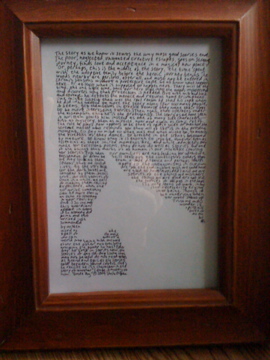
Once framed, the result was something like this:

Guide Dog (framed)

Neil Gaiman arrived in Decatur in a bank of fog and rumbles of thunder.  He read from his work, voices and everything, answered questions and signed for many, many hours.  (If you care to read it, I have a more detailed account of that night on my LiveJournal here.)  I presented my work to him and I’m reasonably sure he liked it.

Prints of this work are not available.

The original has been given to Neil Gaiman.