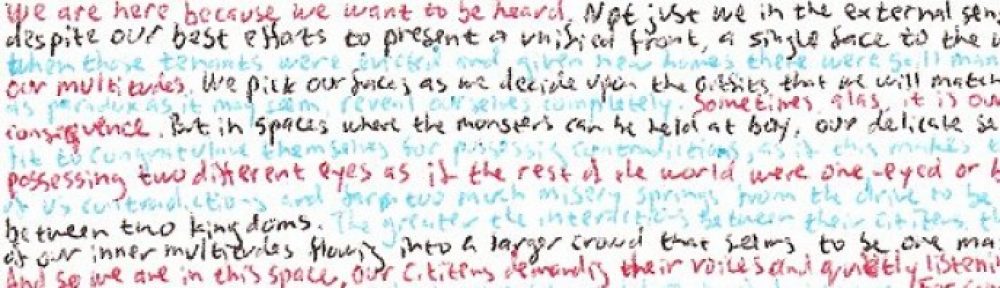
When I was in high school back in the 20th century, I was introduced to the concept of free writing. I was taking Advanced Placement English (which is much like a regular English class, except that they expect more of you) and the teacher started each class by playing a song on a primitive device called a ‘cassette player’ and giving us the length of one song to write whatever happened to be in our heads on a sheet of notebook paper. Random observations, lyrics, elations, frustrations, whatever. To give us something resembling an assignment to hand in, we had to type up one of our pages for his perusal each week. I recall that the typed-up pages I produced were heavily embroidered with bracketed comments, per his instructions, to explain what exactly the heck I was going on about.
My first English class in college also had me free writing. (I recall the girl sitting next to me looked completely baffled at the concept. “It’s easy!” I said cheerily, “Just write whatever comes into your head!” She gave me the blankest look I’d ever been given.) At some point around that time, I can’t recall exactly when, I picked up a small pocket-sized hardbound journal with a silhouette of a cat looking down at a knocked-over vase. Originally, I’d bought it for the Writing Down of Brilliant Ideas that writerly types are supposed to be struck with. Instead, I found myself free writing into it at random intervals, while waiting for things or needing to clear my head. I dubbed it my ‘catbook’ and the name stuck even as I used that one up and moved on to other small books for scribbling in.
When I was in high school back in the 20th century, I was introduced to the concept of free writing. I was taking Advanced Placement English (which is much like a regular English class, except that they expect more of you) and the teacher started each class by playing a song on a primitive device called a ‘cassette player’ and giving us the length of one song to write whatever happened to be in our heads on a sheet of notebook paper. Random observations, lyrics, elations, frustrations, whatever. To give us something resembling an assignment to hand in, we had to type up one of our pages for his perusal each week. I recall that the typed-up pages I produced were heavily embroidered with bracketed comments, per his instructions, to explain what exactly the heck I was going on about.
My first English class in college also had me free writing. (I recall the girl sitting next to me looked completely baffled at the concept. “It’s easy!” I said cheerily, “Just write whatever comes into your head!” She gave me the blankest look I’d ever been given.) At some point around that time, I picked up a small pocket-sized hardbound journal with a silhouette of a cat looking down at a knocked-over vase. I’d bought it for the Writing Down of Brilliant Ideas that writerly types are supposed to be struck with. Instead, I found myself free writing into it on a regular basis. I dubbed it my ‘catbook’ and the name stuck even as I used that one up and moved on to other small books for scribbling in.
These books may well have saved my life. Or, at the very least, made it much more bearable. I emerged from college into a recession-tightened job market and found myself taking public transportation to various menial jobs. I filled many a catbook during the drawn-out journeys from bus to train to destination. Over time, I came up with other ways to make use of the fine art of free writing–some adapted from other sources, others pretty much sprung from trying something and finding it worked.
Free writing is so ridiculously easy that I suspect that’s why so few people seem to do it. They may assume that something so simple couldn’t be of any help to them. Then again, walking is pretty simple, but people use walking to lose weight, strengthen their bodies and even as a way to meditate. Not bad for putting one foot in front of the other.
The main rule of free writing is to write down what’s in your head without going back and fixing anything. That’s pretty much it. All other parameters are subject to change and this blog will be talking about those parameters and when and why to apply them.
If you’ve never, ever done it before, it might seem a bit odd to you. You may think, “oh, crap, I can’t think of anything to write” at which point you write down the words oh, crap, I can’t think of anything to write and you’re on your way. You may think “geez, this is so stupid” and, well, write down geez, this is so stupid and, yeah, I think you get the idea. You may be disappointed to discover that you can’t come up with anything more profound than I want a grilled cheese sandwich and my neck is sore. Relax. If you haven’t done it in a while (or if you haven’t done it ever) it can be a bit like cleaning out a junk drawer and finding all the expired coupons and keys that don’t fit any locks. Once you get all that out of the way, you may find more useful things buried underneath.
While my first experience with free writing required me to hand in a neatened-up version of the results periodically (I suppose to prove that I was indeed doing it) most of not all free writing should be written with the expectation that nobody is going to read it other than you. This allows you to write without mentally glancing over your shoulder to wonder What Will People Think. Who cares? This isn’t for them. This is for you. (In fact, for some of these methods, I recommend that you destroy the results afterward so even you can’t read them again.)
So, if you’re new to this (or even if you aren’t) here’s your homework assignment: Get one sheet of notebook paper and a working pen. Go somewhere you will be left alone, whether it’s your bedroom or your favorite coffee shop. Start at the top of the page and write until you’ve hit the bottom. If you’re feeling up to it, do both sides. Note how you feel before and afterward. If, like me, you feel better than when you started, hello and welcome to my writing habit. Come back and I’ll show you some more fun you can have with this stuff.
A revised version of this entry can be found in the ebook Catbooks and Other Methods.