Word Art: Venus [Astronomy Series]

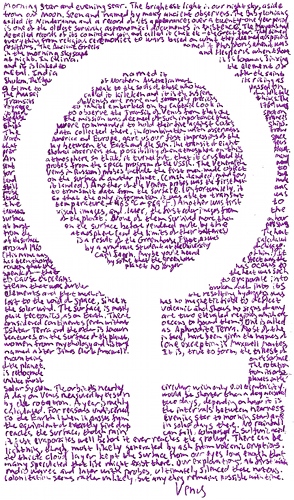
This one, of course, confuses from a distance because the symbol for the planet Venus is also the common symbol for “female.”  It probably didn’t help that I used the purple ink for this one–though I could have gone the distance and made the thing pink.

Venus

Venus

Morning star and evening star.

The brightest night in our night sky, aside from our Moon.

Seen and named by many ancient observers.

The Babylonians called it Nindaranna and a record of its appearances over a twenty-one year period is one of the oldest surviving astronomical documents in existence.

The Mayans had detailed records of its coming and going and called it Chak-ek–the Great Star.

They timed everything from religious ceremonies to wars based on what they deemed auspicious positions.

The Ancient Greeks named it Phosphorus when it was in the morning skyscape and Hesperus when it shone at night.

In China, it is known as Jinxing and it is linked to the element of metal.

India named it after the saint Shukra.

The Yolgnu of Northern Australia mark its rising as a time to speak to the souls of those who have passed on.

The Maasai called it Kileken and it is the subject of a folk tale.

Transits of Venus are rare and strangely precious things.

The voyage to Tahiti embarked on by Captain Cook in 1769 was in part to observe the Transit of Venus from that one spot on the globe.

The mission was deemed of such importance that France’s ships were commanded to hold their fire against Cook’s ships.

The data collected there, in combination with observations from North America and Europe, gave us our first impressions of the space that lay between Earth and the Sun.

The transit of eight years prior showed observers the possibility of an atmosphere on this planet.

An atmosphere so thick, it turned out, that it crushed the many sent probes from the space program of the USSR.

The Venera (the word for Venus in Russian) probes include the first man-made object to land on the surface of another planet.

(Crash-landed, mind you, but still it landed.)

Another of the Venera probes was the first man-made probe to transmit data from the surface.

(Unfortunately, it was stuck so that the only information it was able to transmit was the temperature–65° C or 869° F.)

Another was first to transmit visual images and, later, the first color images from the surface of the planet.

None of them survived more than an hour at most on the surface before rendered mute by the pressures from the atmosphere (and the limits of their batteries.)

The heat of the surface is a result of the Greenhouse Effect as was calculated around 1960 by a graduate student at the University of Chicago.

(His name was Carl Sagan.  Maybe you’ve heard of him?)

It has been thought by some that the greenhouse effect was the reason that the planet no longer has oceans to speak of–that the heat was such to cause the oceans to evaporate into steam that was further broken down into its elements and that much of the resulting hydrogen was lost to the void of space, since it has no magnetic field to deflect the solar wind.

The surface is mostly volcanic and shows no signs of any plate tectonics, as on Earth.

There are two elevated regions which are considered continents (even without oceans to bound them.)

One is called Ishtar Terra and the other is known as Andromeda Terra.

Most of the features on the surface of the planet, in fact, have been given the names of women from mythology and history.

(One exception is Maxwell Montes, named after James Clark Maxwell.  It is, true to form, the tallest of mountains on the surface of the planet.)

The rotation is retrograde from its orbit, unlike most planets in the Solar System.

The orbit is nearly circular, with only 0.01 eccentricity.

A day on Venus measured by the sun would be shorter than a day measured by the rotation.

A year is roughly two days, depending on how it is calculated.

For reasons undiscerned, the intervals between nearness to the Earth (when it passes from evening star to morning star) are the equivalent of exactly five days in solar days there.

No rainfall reaches the surface, though rain can fall, composed of sulfuric acid, it just evaporates well before it ever reaches the ground.

There can be lightning, though, most likely generated by ash from volcanic eruptions.

The thick cloud layer kept the surface from our eyes long enough that many speculated that life might exist there.

Our explorations, at first with radio waves and later with probes, ultimately silenced those notions.

Colonization seems rather unlikely, but anything remains possible with time.

Did I mention that Wikipedia was my friend?  The mention of the Venera probes linked to a detailed entry that listed every mission in the program, when it was launched, how long the probe survived and more.  I generally picked out the facts and information in order of what was interesting to me and got better at sifting through things as I progressed further out into the solar system.  The results would be lousy as an elementary school science report, but they work well enough as the background for this particular illustration.

Prints of this work are available here.

The original is not for sale.

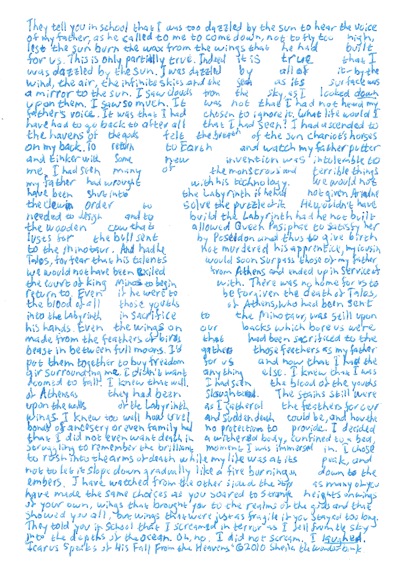
Word Art: Icarus Speaks of His Fall From the Heavens

I’m doing this all wrong, aren’t I?  I should have worked my way through the Astronomy Series, maybe even a planet a day and then gone on to the rest of my art box.  But instead I go off and get all excited about this one piece I just finished yesterday and decide to do a blog post about that instead.

This was an idea I had bapping around in my head for a rather long time but had never got around to actually writing down until I decided to render it in Word Art form.  (This happens a lot to ideas I have–they seem to not come into their own until I find the right ‘container’ for them.  A couple of short story ideas of mine eventually blossomed into novels, for example.)  I’m probably not the first to have suggested that Icarus flew too close to the sun not out of ignorance, but as a deliberate choice.

Icarus Speaks of His Fall From the Heavens

Icarus Speaks of His Fall From the Heavens

They tell you in school that I was too dazzled by the sun to hear the voice of my father, as he called me to come down, not to fly too high, lest the sun burn the wax from the wings that he had built for us.

This is only partially true.

Indeed it is true that I was dazzled by the sun.

I was dazzled by all of it–by the wind, the air, the infinite skies and the sea as its surface was a mirror to the sun.

I saw clouds from the sky as I looked down upon them.

I saw so much.

It was not that I had not heard my father’s voice.

It was that I had chosen to ignore it.

What life would I have had to go back to after all that I had seen?

I had ascended to the havens of the gods, felt the breath of the sun chariot’s horses on my back.

To return to Earth and watch my father putter and tinker with some new invention was intolerable to me.

I had seen so many of the monstrous and terrible things my father had wrought with his technology.

We would not have been shut into the Labyrinth if he had not given Ariadne the clew in order to solve the puzzle of it.

He wouldn’t have needed to design and to build the Labyrinth had he not built the wooden cow that allowed Queen Pasiphae to satisfy her lusts for the bull sent by Poseidon and thus to give birth to the Minotaur.

And had he not murdered his apprentice, my cousin Talos, for fear that his talents would soon surpass those of my father, we would not have been exiled from Athens and ended up in service of the court of King Minos to begin with.

There was no home for us to return to.

Even if he were to be forgiven the death of Talos, the blood of all those youths of Athens, who had been sent into the Labyrinth in sacrifice to the Minotaur, was still upon his hands.

Even the wings on our backs which bore us were made from the feathers of birds that had been sacrificed to the beast in between full moons.

I’d gather those feathers as my father put them together to buy freedom for us and now that I had the air surrounding me, I didn’t want anything else.

I knew that I was doomed to fall.

I knew that well.

I had seen the blood of the youths of Athens as they had been slaughtered.

The stains still were upon the walls of the Labyrinth as I gathered the feathers for our wings.

I knew too well how cruel and sudden death could be, and how the bonds of ancestry or even family had no protection to provide.

I decided that I did not even want death in a withered body, confined to a bed, struggling to remember the brilliant moment I was immersed in.

I chose to rush into the arms of death while my life was at its peak, and not to let it slope down gradually like a fire burning on down to the embers.

I have watched from the other side of the Styx as many of you have made the same choices as you soared to strange heights on wings of your own, wings that brought you to the realms of the gods and showed you all, but wings that were just as fragile if you stayed too long.

They told you in school that I screamed in terror as I fell from the sky into the depths of the ocean.

Oh, no.  I did not scream.  I laughed.

Before you congratulate me on my knowledge of Greek myth, I should clarify that I myself knew only the basics of the story of Daedelus and Icarus until the Internet was kind enough to tell me the rest.  I am particularly indebted to the University of Virginia Library for hosting a translation of Ovid’s Metamorphoses that provided an index and hyperlinks.  Those details alone were enough to take up most of the allotted space and the comparisons between the flight of Icarus and of those who seek a different way to fly were reduced to an afterthought, which I’m actually quite fine with.  This was, I think, the first Word Art piece I’ve done where I did the radical idea of drafting the words out first before committing them to artwork.  There were, obviously, some shifts between the draft and the final, as the right word or turn of phrase would need to be shortened or lengthened to fit the space.  It also allowed me to cut lines that I decided didn’t quite fit before I’d permanently committed to them.

The image is a very sloppy homage to Henri Matisse.  Doing an exact copy of his own Icarus would have been pushing it, I think.  My first attempt had the ‘feathers’ drawn too narrowly to be distinct from the usual spaces between words so I set it aside and began anew about an inch and a half into it.  It definitely gave me some more insights into what works and what doesn’t in terms of words and white space.

Prints of this work are available here.

The original is not for sale.

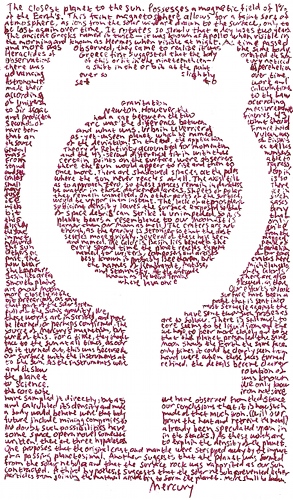
Word Art: Mercury [Astronomy Series]

About a month into my art career, I got it in my head that I would enter the art show at Chattacon, a little science fiction convention that I normally go to each year.  I downloaded and read the rules and realized that I’d need something to fit the proper themes of the show.

“I know!” I said to myself, “I’ll do a Word Art piece for each of the planetary symbols!”

Never was the timeworn phrase “easier said than done” more appropriate.  Granted, it did simplify things enormously–I wasn’t forced to rack my brain to come up with ideas and the titles were already in place before I even embarked on writing the words.  (Normally, titles come at the end rather than the beginning, which can make things tricky at times.)  The wonders of Google image search found me a picture of the planetary symbols from a NASA website and a little tinkering with GIMP rendered them the appropriate size so I could trace them to fit the 3″ x 5″ spaces I’d marked out on 5″ x 7″ sheets of paper to fit in a matching set of dollar store frames.

Then I had to actually write the words.  I checked a book out of the library to work from, because I wanted the solidity of paper reference, though I gathered the bulk of the information from the wonders of Wikipedia.  This is far safer than it may seem, since the Internet is not lacking for people passionate about science who will eagerly fact-check and verify nearly every line of such entries.  (As someone wryly observed, the thing about Wikipedia is that it works well in practice but it’s a disaster in theory.)

I wanted the words to be factual, though they were still subject to the mad poetical filter that the words tend to go through when they run from my head to the page, and it is entirely possible that there are some scientific inaccuracies contained within.  As the series progressed, I got better at gathering the information that was of the most interest to me and putting it to use filling in the spaces to define the symbol on the page.

I started with Mercury.

Mercury

Mercury

The closest planet to the sun. Possesses a magnetic field of 1% of the Earth’s.

This faint magnetosphere allows for a faint sort of atmosphere, as ions from the solar wind are drawn to the surface, only to be lost again over time.

It rotates so slowly that a day lasts two years.

The ancient Greeks named it twice–it was known as Apollo when visible in the morning and known as Hermes when visible at night.

As time passed and more was observed, they came to realize it was the same body.

Heraclides of Greece first suggested that the body orbited the sun.

Observations of this orbit in the nineteenth century noticed there was a shift in the orbit at the point of perehelion advancing ever so slightly over time.

Astronomers set to work and made their calculations according to the Law of Universal Gravitation according to Sir Isaac Newton.

However, the measurement and prediction had a gap between the two figures.

43 seconds of arc was the difference between what should have been and what was.

Urbain LeVerrier of France held that an as-yet-unseen planet, which he named Vulcan, was the source of the deviation.

In the end, the application of Einstein’s General Theory of Relativity accounted for momentum as well as mass and the 43-second difference fit in with those numbers.

From certain points on the surface, were observers able to stand there the sun would appear to rise and then to regress, and set once more.

There are shadowed spaces on the poles deep in craters where the sun never reaches at all.

The axial tilt is so small as to approach zero, so these spaces remain in darkness.

There may be water in those darkened areas, sheets of polar ice in place that remain unmelted.

On other parts of the surface, such ice would be vapor in an instant.

The lack of atmospheric gases with sufficient density leaves the surface exposed so that any bit of space debris can strike unimpeded.

So it is that this planet bears a resemblance to our Moon. (It is only slightly larger than our Moon as well.)

The craters are not quite the same, though, as the gravity is stronger so that the dust from the impact settles more quickly.

Several of these have been mapped, measured and named.

The Caloris Basin lies beneath the peak of the sun every second time the planet reaches the point of perehelion.

Others are named for writers, composers and artists of our times past.

The best known is probably Beethoven, but craters here now bear the names of Rembrandt, Matisse, Michelangelo, Shakespeare and Stravinsky.

At the antipode of the Caloris Basin lies an area known as The Weird Terrain.

There are also smooth plains where lava once flowed, as there are on our Moon.

Our efforts to look more closely at the surface have been a bit precarious, as any probe that is sent into that part of the solar system must struggle against the pull of the Sun’s gravity.

We have sent two such probes as these words are inscribed, and more are to follow.

There is still much to be learned, or perhaps confirmed.

The core seems to be liquid iron and the source of Mercury’s magnetism, but we hope to peer more closely and to be sure of this.

For a time, they thought that the planet presented the same face to the sun at all times, as our Moon shows the Earth the same face.

As it turned out, this was because the only times it could be clearly seen from our surface with the instruments at hand were when those faces turned to the sun.

As the instruments were refined, the details became clearer and the slow rotation of the planet was known to science.

We only know the core to be iron not since we have sampled it directly, but as we have observed from the distance and calculated its density and made our conclusions that it is how such a body would behave were that body made of that much iron.

(Will our future include mining companies to brave the heat and retreive [sic] the metal? No doubt such possibilities have already been speculated upon in some space opera novel somewhere in the stacks.)

As these words are written, there are three hypotheses to explain the density of the planet.

One proposes that the original crust and mantle were stripped away by the impact of a passing planetesimal.

Another suggests that the planet was formed from the solar nebula and that the surface rock was vaporized as our Sun contracted.

A third hypothesis suggests that the solar nebula prevented lighter particles from joining the material accreting to form the planet.

More shall be known.

It didn’t sell.  None of them did, perhaps because originals generally don’t sell well at that particular art show (or so I was told as I was checking my work out at the end of the weekend.)  It’s also possible I priced it a bit too high–I’ve since dropped my pricing to five dollars per square inch, having been taught by this that ten per square inch may be asking a bit much for an as-yet-unproven artist.

I did get many positive responses, though, which was encouraging.  I’m considering doing a series of the astrological symbols at some point, though I’ll need to get twelve matching frames together for that, so it may take a while.

Prints of this work are available here.

The original is not for sale.

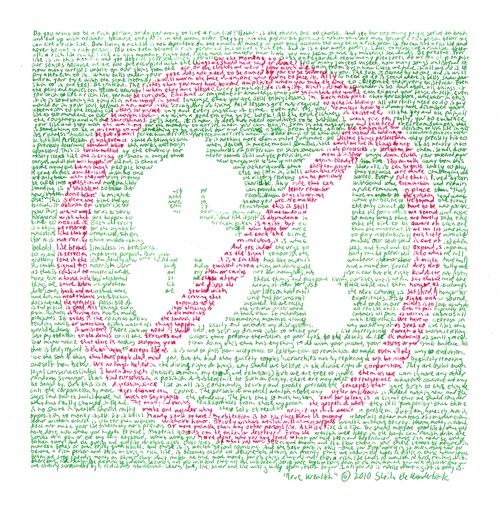
Word Art: True Wealth

Do you want to be a rich person, or do you want to live a rich life?

The question came to me while I was doing my Three Daily Pages and it’s a phrase I try to keep in my back pocket as a perpetual reminder.  This was my effort to turn that idea into artwork.  I placed it in an 8 x 10 frame that previously had a picture with Terry Bozzio’s autograph on it.  (Long story, that.)

I tinkered with fonts in GIMP until I came up with one that gave the dollar sign and exclamation point a certain pop art sensibility to me.  I printed out the results and traced it on a light table, then got out the compass and straight edges to sketch out a no symbol on top of it.  Then I got out the green and red pens and went at it.

True Wealth

True Wealth

Do you want to be a rich person, or do you want to live a rich life?

“Both!” is the obvious one to choose.

And yet far too many people strive for both and end up with neither, because they do it in the wrong order.

They buy into the popular but pernicious notion that one must become a rich person before one can live a rich life.

But living a rich life is not dependent on the amount of money in your bank account the way being a rich person is.

You can live a rich life and never become a rich person.

You can even become a rich person and fail to live a rich life.

And it is a far worse poverty, I feel, to never live a rich life.

After all, a rich life can be lived at any moment, right here, right now, no matter how little you may seem to have by material standards.

Be present.

Your life is in this moment and you deprive yourself when you allow the moment to pass unregarded.

How many pleasures do we let slip on past our senses because we are too preoccupied with things we should have said or done?

How many sunsets unseen, how many songs unlistened to, how many caresses unfelt on our skins from the air, or the clothes we wear?

How much we gain from even how little we have if all we do is to pay attention to it.

What falls under your gaze does not need to be owned by you to be savored by you.

The sun is owned by no one and it will warm your face with the same intensity it will warm the face of anyone who turns to face it.

All you need to do is stand where it falls, show your skin to it and feel.

Be grateful.

The riches that you have become amplified when you take the time to celebrate their very existence.

Even the pains and agonies can become beautiful when they are blessed.

Every breath of life is a gift.

Kindly do not squander it so.

And above all things, if you wish to live a rich life, you must be curious.

Each new fragment of knowledge that you gain about the world can expand your sense of self, even if it is something as tiny as a new word in some language that you are still taking lessons in.

Each new place that you explore, whether in this world or in your soul, becomes a new word in the vocabulary of living.

Paid lessons are not required to acheive [sic] fluency.

All you really need to do is pay attention to the lessons life offers to you are any and every instant of time.

Even you. Yes, you.

No matter how you may have dismissed your life as too mundane to ever be worth looking at with a penetrating gaze, Look! All the true richness of existence, all the joy and all the pain, all the roughness and all the smoothness.

It is here, it is now, it does not need conditions to be fulfilled.

I want you, yes, really, you to embrace your life and stop with the waiting for the moment to arrive when you can begin.

Even in the most grimy and tattered of circumstances, there is something to be a witness to and something to be grateful for and curious about.

From there, all can be embraced.

Your decision to live life in all its richness should not be put off until perfection arrives.

Perfection arrives when you allow things to be what they are instead of holding to a standard that can never be fulfilled.

Perfection is not even a state of being as such.

It is nothing more than a value judgment.

We declare things perfection when they precisely fit to a previously determined standard.

While this works well enough when dealing in mathematical formulas, in the world we live in things do not fit as neatly into equations.

This is further muddled by the tendency for standards of perfection to shift somewhere in the processes of striving for them.

So much of our misery seems like one is trying to shoot a target that never stands still and yet provides no meat if it is ever brought down.

Clutch your tattered paper targets and all that will happen in the end, is that a new target will be set up all over again.

(Ready?? Aim. Fire.)

You can walk away from this game at any time but not enough people know any other games that they can play.

After all, it can be quite lonely to play a game of one’s own devising with no one else to join in.

Still, when the rules you write are made challenging and are only broken when they are truly in the way, the victory resulting can be particularly sweet.

Every rule that is lived by can be called into question and more than likely should be.

Any rule that can withstand some examination and remain standing is a sensible one to follow.

But–if you can provide no better reason for a rule remaining in place than “That’s how it’s been done before” it might need a reconsideration or at the very least have an answer to the question “and what else?”

This is the one time that you have to be who you are.

No matter what you believe to lie beyond the final breath, if oblivion or afterlife or even if reincarnation this is still the only chance you have to be who you are now.

There are no ways for us to start all over again from infancy.

All we can do is take the point where we stand and move forward with what we happen to have.

And life itself is abundant in so many ways that we barely take the time to notice it.

Each and every breath taken is a gift, but to take the time to be aware of each one is a thing we reserve for the saints or those who hope for more than the material.

If we can let something miraculous like that go unnoticed, then if we took the time to pay attention to each little miracle (for it is not rarity that makes a thing miraculous, it is what makes our soul stand in awe of it) then behold, life becomes limitless in treasures.

And, yes, indeed the urge to seek and find and to expand is important to us, and it serves an important purpose.

But just as the signal to nourish body can be perverted into what we call gluttony (one of the seven deadly sins, one could add but it is a sin that has lost much of whatever glamor that it might have had) so can the signal to nourish our souls end up twisted into a thing we don’t quite have a name for.

“Greed” does not fully work as that is confined to material wealth and very often our cravings are for intangibles, not just a car but the right kind of car, not just a house but a house in the ‘best’ neighborhood so we chase after these things and postpone living our lives until we can say that we have the things we crave.

When we get them (if) we digest the having of them for just a little while and then hunger, as it always does, comes back and we are back where we started with our lives on hold until the next craving is satisfied.

A hunger for food does not need elaborate satisfaction.

A craving that one has for sensual experiences, if it be sight, touch or sound, does not need the greatest possible of expenses to be satiated.

All we really need to do in our minds is to look at what is and to find it good.

All things turn into blessings of the greatest order when we realize this.

Even the pain. Especially the pain.

Richness of living can not be made of the moments without flaw.

It includes and embraces all pain as well as it embraces all pleasures.

It takes in the rough as well as the smooth, the stammering moments along with eloquence.

We have no interest in reading novels or watching films where all things happen easily and without any disruption.

Why would any of us seek to live lifes [sic] that would be dreary if written?

There isn’t any need, I should add, to stir up drama just to make your life interesting enough to be worth retelling.

Just pay attention to the details to all the textures and colors that present themselves to your eyes, to the details of life the moments of small grace.

You might notice that there is nothing stopping you from doing this that has anything to do with your income, your assets or your bank balance.

All that is truly required is the willingness to accept life as it is and to pass from acceptance to celebration to revalation [sic] to maybe even all the way to revolution.

Not the sort of thing that leaves people dead, mind you, but the kind that quietly topples hierarchies not by replacing the top, but instead by quietly removing oneself from below.

We no longer believe in the divine right of kings, why should we believe in the divine right of corporations?

They are useful enough legal constructs (indeed I have a few such entities among my friends and relations) but we are free to ignore them as we can ignore any other random stranger.

If we find ourselves in a position of subservience to such an entity, there are many ways to renegotiate whatever contract we may be bound by.

But this is a digression, since life in all its confounding beauty and trouble precedes the concepts that gave birth to this thing we call the corporation by more ages than we can count.

The pursuit of material wealth above any other consideration is indeed nothing new and the sages (and even the fools) have had much to say against the tendency.

The fact that so much as been said for so long is a signal that we should consider what has really changed in the end.

The many and various reassurances from those who preach the gospels of what they call ‘prosperity’ that there is no shame in wealth should really make one wonder why they felt the need to bring it up if it wasn’t a problem.

But I am, honestly, not in opposition to money itself. It is still handy stuff to have.

My objection is to the placement of money above all other matters of consideration.

Honor without wealth is greater than wealth without honor.

Beauty without wealth will always surpass wealth without beauty.

Having money in the bank does not make your life inherently more precious or more valuable than any other person’s life.  A life is a life is a life.

You should measure your life by what you have done, not by what you happen to have.

Material goods can be taken or destroyed.

Even the wealth we keep in the bank can vanish with the stroke of a pen or the tap of a keyboard.

What what [sic] you have done, who you have loved, what you have seen and experienced, those can never be truly taken away.

And the purity and quality of those acts, those loves, of what you have seen and known and let flow through you, these cannot be measured in market forces or even truly quantified.

And thus is it wealth beyond counting.

And the best part is this–once you stop worrying so much about how to become a rich person and focus on living a rich life, it becomes easier to decline the drains on money that we allow in the hopes of filling in the hollow spaces.

When we stop spending money on things that don’t matter we have more money for the things that do and thus a rich life leads to wealth in both realms of it.

Therefore, life richly–be present, be grateful, be curious and you will find that all else will follow.

Strip your expectations down to the minimum and you will discover that you are already surrounded by ridiculous abundance.

Learn, love, live, savor and life will gladly open itself to you if all you do is notice what a gift it truly is.

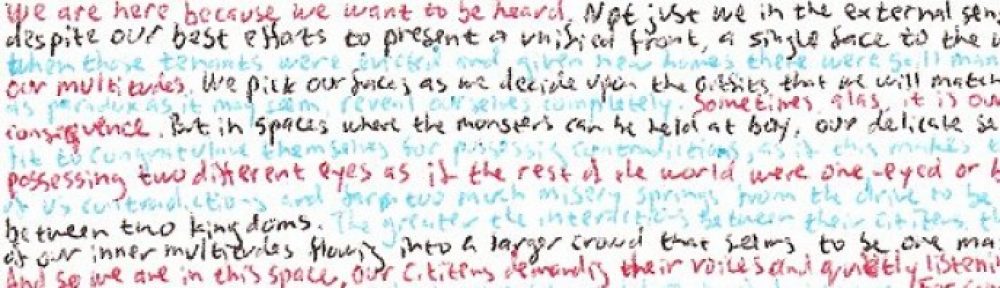
2,103 words, in case you wondered.  It took me over an hour to transcribe the results.  Somewhere halfway through, I decided to sketch in lines to guide the text instead of using the edge of a piece of paper, as I’d been doing previously, and found the going a good deal smoother.

Because I took to pricing my art at five dollars per square inch, it is with some amusement that I note that it was the most expensive piece on my table at the Upper West Side Folk Art Market.
Prints of this work are available here.

The original is not for sale.

Word Art: Contraction and Expansion

This one was created on the first day of 2010 to fill in a small black frame I’d picked up in a thrift shop run.  I suppose it would have been appropriate to do something about new beginnings or fresh starts, but instead I did this:

Contraction and Expansion

Contraction and Expansion

This is what they try to tell us: that the world is diminishing, the world is collapsing and contracting.

What is little will soon be less, and we’d best grab what we can while it can still be obtained from the fading supply.

Everything will run out, they tell us, so many people in the world want what we have and it must be defended from being taken away from us.

Hold on to your gold and your cash, they tell us, or it disappears into nothing.

But what if this was not really true?

What if there really was more than enough for all of us?

What if we stopped the perpetual chase for a lifestyle that cannot be sustained in the limits of our resources and found ways to make sure that all were fed and clothed and well and free to life life in all its marvel and wonder?

Do any of us really need more house than we can occupy or money than we can ever hope to spend?

What if we truly learned to be content and no longer needed to buy things we barely use?

What if we learned to measure wealth in how we make use of the gift of life instead of how much owned?

The thoughts were cut off abruptly by the limitations of space, which is probably why I made True Wealth so large to make up for that, since I have much to ramble about on that subject.  I gave serious thought to scrapping this one entirely and starting all over, but it seems to have settled into place and now I am reluctant to destroy it.

Prints of this work are available here.

The original has been sold.

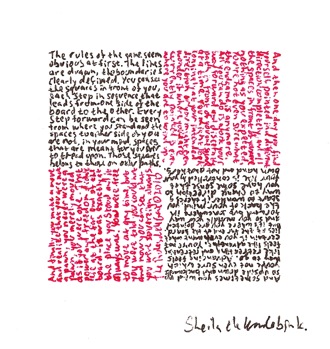
Word Art: The Rules of the Game

This piece was started in the middle of the Upper West Side Folk Art Market (because I needed something to do while waiting for people to drift past my table, squint at my work, nod, smile and wander on) and eventually finished at home a week or two later.  While sometime I can crank out a piece in one sitting, other times they get picked up, worked on, set aside and picked up again later, like a knitting project.  I’d wanted to see if a directional change in the words would work or not.

The Rules of the Game

The Rules of the Game

The rules of the game seem obvious at first.

The lines are drawn, the boundaries clearly defined.

You can see the squares in front of you, each step in sequence that leads from one side of the board to the other.

Every step forward can be seen from where you stand and the spaces to either side of you are not, in your mind, spaces that are meant for you ever to tread upon.

Those squares belong to those on other paths.

And then one day you find yourself pointed in a different direction completely, and all the spaces in front of you are nothing as you expected.

You’re not even sure what the endgame is anymore.

All you can do is work you way forward and discern the path in front of you on square at a time.

You might look longingly at you intended direction or you might even wonder if where you are currently pointed is even where you are to wind up.

And sometimes you wind up so upside down and backwards you’re not even sure which way to go.

Advancing feels like retreating and retreating feels like advancing.

You’re not certain if you even want what lies at the far end of the board.

But it’s where you are pointed and so you muddle you way forward by somewhere in the back of your mind, you start to wonder if there’s a way to change direction so you have some sense that your life is controlled by your own hand and not another’s.

And finally you make a move and realize that you are not a pawn, you never were a pawn, you merely moved as if you were one.

That power and freedom didn’t lie at the far end of the board–it was exactly at the place you stood and it always was.

You were free to move at any time, but you were told you could not and now you can see that you were sovereign always.

It’s at least a little easier to follow than Spiral and a good deal less depressing to read than Exile.  Perhaps I’m getting the hang of this.

Prints of this work are no longer available.

The original has been sold.

Word Art: Moons, Stars, Comets and Other Possibilities

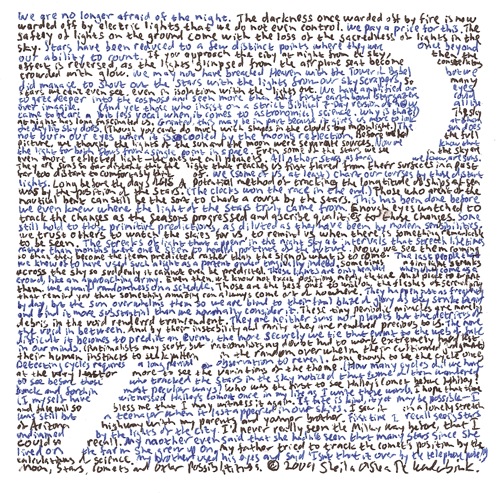
As I’ve mentioned, when making Word Art I pencil in the boundaries before I begin writing, so I can shape the words accordingly.  I’d wanted to do one about a night sky, and so I penciled in a crescent moon and some stars and took to writing in that general direction.  Somewhere in the middle of it, I whipped out my pencil and added another shape to work around, based on what I’d been writing.  It’s the first and thus far only time I’ve done that with my work.

Moons, Stars, Comets and Other Possibilities

Moons, Stars, Comets and Other Possibilities

We are no longer afraid of the night.

The darkness cone warded off by fire is now warded off by electric lights that we do not even control.

We pay a price for this.

The safety of lights on the ground come with the loss of the sacredness of the lights in the sky.

Stars have been reduced to a few distinct points where they were once beyond our ability to count.

If you approach the city at night from the sky, then the effect is reversed, as the lights glimpsed from the airplane seat become constellations crowded with glow.

We may not have breached Heaven with the Tower of Babel but we did manage to shout out the stars with the lights from our skyscrapers.

So many stars we can’t even see, even in isolation with the lights out.

We have amplified our eyes to gaze deeper into the cosmos and seen more than the first earthbound stargazers could ever imagine.

(And yet those who insist on a strict biblical 7-day version of how all life came to be are a bit less vocal when it comes to astronomical science. Why is that?)

The sky at night has long fascinated us.

Granted, this may be in part because it gives us more to look at than the daylit sky does.

(Though you can’t do much with shapes in the clouds by moonlight.)

The sun does not burn our eyes when it is so cooled by the moon’s reflection.

Before we had the full picture, we thought the lights of the sun and the moon were separate sources.

Now we know that the light for both flows from a single point in space.

Even some of the stars we see in the sky are even more reflected light–the ones we call planets.

All other stars, as far as we know, are suns.

They are suns so far distant that the light that reaches us first flared from their surfaces in a past far too distant to comfortably think of.

We (some of us, at least) chart our courses by those distant lights.

Long before the days of GPS, a potential method of tracking the longtitude [sic] of ships at sea was by the position of the stars.

(The clocks won the race in the end.)

Those who aren’t of the nautical bent can still be the sort to chart a course by the stars.

This has been done before we even knew where the light of the stars truly came from.

Enough eyes watched to track the changes as the seasons progressed and ascribe qualities to those changes.

Some still hold to those primitive predictions, as diluted as they have been by modern sensibilities.

We trust others to watch the skies for us, to remind us when there is something remarkable to be seen.

The streaks of light that appear in the night sky at intervals that stretch lifetimes rather than months were once seen to herald portents of the future.

Now we see them coming so that they become the item predicted rather than the sign of what is to come.

The last people that we know of to have used such a light as a portent ended tragically indeed.

Sometimes a tiny light streaks across the sky so suddenly it cannot even be predicted.

These lights are only heralded when they come as a crowd, like an approaching army.

Even then, we know now exact positions, merely the time and place to expect them.

We await randomness on a schedule.

Those are the best ones to wish on, the flashes of serendipity that remind you that something amazing can always come out of nowhere.

They happen just as frequently by day, but the sun overwhelms them so we are blind to their final blaze of glory as they strike the air and find it more substantial than we normally consider it.

These tiny periodic miracles are merely debris in the void rendered transcendent.

They are neither suns nor planets but the detritus of the void in between.

And by their instability and rarity they are rendered precious to us.

The more difficult if becomes to predict an event, the more securely we tie that event to the web of fate in our minds.

(Rationalists may scoff, but rationalists no doubt had to work extremely hard lest their human instincts to seek pattern in the random overwhelm their cultivated judgment.)

Detecting cycles requires a long period of observation to reveal.

Long enough to see the cycle once, at the very least, or more to see the variations of the theme.

(How many cycles did we have to see before those who tracked the stars in the sky noticed that some of them wandered back and forth in most peculiar ways?  Who was the first to see Halley’s Comet before Halley?)

(I myself have witnessed Halley’s Comet once in my life as I write these words.

I hope that time and fate will so bless me that I may witness it again.

If fate is kind, it yet may be possible–I was still but a teenager when it last appeared in our skies.

I saw it on a lonely stretch of Arizona highway with my parents and younger brother.

First time I recall seeing stars undimmed by the lights of the city.

I’d never really seen the Milky Way before, that I could so recall.

My mother even said that she hadn’t seen that many stars since she lived on the farm she grew up on.

My father tried to track the comet’s position by the calculations of science.

My brother used his eyes and said “Isn’t that it over by the telephone pole?”)

Yeah, I know, what’s with the parentheses?  Since I am making this stuff up as I go along, I can wind up on parenthetical tangents that sometimes don’t even get closed until I’m transcribing them and notice that I need to whip out the pen and make a few corrections.  (Ahem.)

The “stars” came out a little murkier than I would have liked, but it gives me a clearer idea of how small I can go in terms of whitespace and still be visible.  This one was started at one of my nights at The Glenwood and I finished it at Thrive where a band called The Roys had some kind of reunion show.

“The clocks won in the end” makes more sense if you’ve read the book Longitude: The True Story of a Lone Genius Who Solved the Greatest Scientific Problem of His Time by Dava Sobel.  Which, by the way, you really should.

Prints of this work are no longer available.

The original is not for sale.

Word Art: Exile

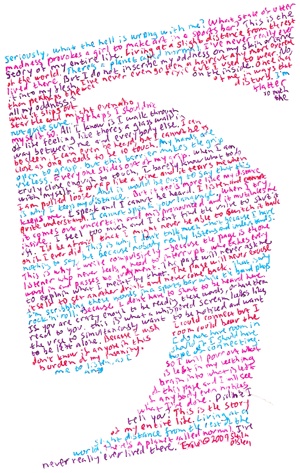
I think of all the materials and objects I use to create my word art, the only ones specifically purchased for artmaking purposes was the pack of Pilot G-2 Mini gel pens that I picked up at an office supply store.  The rest of my art supplies are things that were handed down to me or that I already happened to have.  My father had a desk drawerful of rulers and French curves that he gladly passed on to me, having no more need for them in the age of Macintosh.  I tucked one of them in the storage clipboard I’ve been using to carry my art supplies and one fine night went to see a fun little cover band known as The Intruders play at a downtown sports bar.

My the time I’d elbowed my way to a seat at the bar and gotten settled, I was too frazzled to be patient enough to do nice, neat squared off lines to define the boundaries of the words.  So I did some hasty and skewed ones, added a couple of shapes to work around with the French curves and somewhere among waiting an eternity to be served, ordering an overpriced hamburger, eating it and cleaning up after myself, I composed this.

Exile

Exile

Seriously, what the hell is wrong with me?What state of utter madness provokes a girl to make art in a sports bar?

This is the story of my entire life.Living at a slight distance from the rest of the world.

There’s a planet called normal.I’ve never really ever lived there.

But I do not inscribe my oddness on my skin or carve it into my flesh.

I’ve never even gotten a haircut any more extreme than perhaps the wee pixie cut I used to wear.

No, all my oddness is on the inside.

Once in a while it slips out of me in ways that startle and might even also disturb.

I’m not quite sure. Perhaps I shouldn’t flatter myself so.

All I know is I walk through so much of life feeling like there’s a glass wall in the way between me and everybody else.

I can be seen, I can even be heard, but I cannot be as close as one needs to be to touch.

My hands are open to grasp, but this barrier makes the grip useless.

Everyone slides out of my grip.

When I am truly close enough to touch, I barely know what to do with myself.

I wrap like a vine and it tears me when I am pulled loose.

And it would be easy to say that this is why I keep my distance.

But it feels more like my distance keeps me.

I speak and I cannot be heard. I listen and cannot quite understand.

I cannot speak your language. When I try, it comes out uncertain and mispronounced and it mutilates me inside.

I feel too much and I can’t find the valve to shut it off. I’d be afraid that I might never be able to switch it back on if I ever did.

This is why I don’t talk much–not because I have nothing to say, but because nobody really listens and understands.

This is why I write compulsively–because the page is the one listener who never feels a need to interrupt, who takes every word in and passes no judgment.

The page will never ask me what to explain what I meant by that.

The page will never excuse itself to get another drink and never come back.

That is why I’m scribbling these words in a sports bar while the band plays rock ‘n’ roll.

Because I don’t have to shout to be heard here.

If you are crazy enough to be reading these words, or have them read to you, this is what a whispered scream looks like, the urge to simultaneously want to be noticed and want to be left alone.

Because I wish I could connect but I don’t know if anyone in this room could bear the burden of my insanity.

I do not have room in me to listen, as I should if I should have any hope of connecting.

So I will pour out what is left of my seething brain into what is left of this page and I will see if anybody even notices what I’ve done.

Didn’t I tell you?This is the story of my entire life. Living at a slight distance from the rest of the world.

There’s a planet called normal. I’ve never really lived there.

It looks pretty from a distance, doesn’t it?  Then you get up close and find it’s not pretty at all.  I’m not normally in the habit of using my artwork as catharsis that way–I have Catbooks and Shit Books for that sort of thing–but the time and the place and the circumstance combined so there wasn’t any other kind of work that would have come out of me.

Printout of this work (2 MB .jpg file) available here.  Please read the license details.

Prints of this work are available here.

The original has been sold.

Word Art: Questions Without Answers

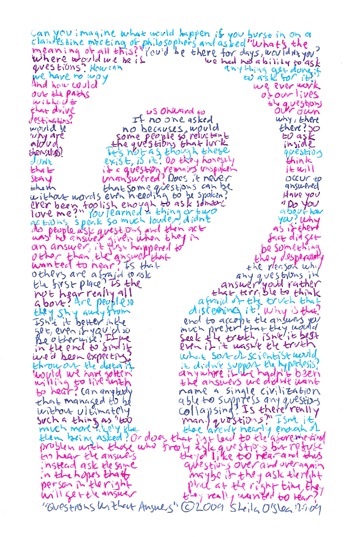
On Wednesday nights at The Glenwood, a jazz combo led by a young man named Taylor Kennedy plays in the corner of one of the rooms.  I’ve taken to toting my materials in a well-worn bag and spending a few hours there, sipping wine, listening to jazz and making art.  Questions Without Answers is probably the first one I completed there, and it was a great deal of fun to create.

Questions Without Answers

Questions Without Answers

Can you imagine what would happen if you burst in on a clandestine meeting of philosophers and asked “What’s the meaning of all this?”

You’d be there for days, wouldn’t you?

Where would we be if we had no ability to ask questions?

How can anything get done if we have no way to ask for it?

And how could we ever work out the paths of our lives without the questions that drive us onward to our own destinations?

If no one asked why, there would be no becauses, would there?

So why are some people so reluctant to ask aloud the questions that lurk inside themselves?

It’s not as though these questions don’t exist, is it?

Do they honestly think that if a question remains unspoken it will stay unanswered?

Does it never occur to them that some questions can be answered without words even needing to be spoken?

Have you ever been foolish enough to ask someone “Do you love me?”

You learned a thing or two about how actions speak so much louder, didn’t you?

Why do people ask questions and then act as if there was no answer given when they in fact did get an answer, it just happened to be something other than the answer that they desperately wanted to hear?

Is that the reason why others are afraid to ask any questions in the first place?

Is the answer you’d rather not hear really all that terrible to think about?

Are people so afraid of the truth that they shy away from discerning it?

Why is that?

Isn’t it better in the end to accept the answers you get, even if you’d so much prefer that they would be otherwise?

If we seek the truth, isn’t it best in the end to find it even if it wasn’t the truth we’d been expecting?

What sort of scientist would throw out the data if it didn’t support the hypothesis?

Would we have gotten anywhere if we hadn’t been willing to live with the answers we didn’t want to hear?

Can anybody name a single civilization that managed to be able to suppress any questions without ultimately collapsing?

Is there really such a thing as “too many questions?”

Isn’t it much more likely that there aren’t nearly enough of them being asked?

Or does that just lead to the aforementioned problem with those who freely ask questions but refuse to hear the answers they’d like to hear and thus instead ask the same questions over and over again in the hopes that maybe if they ask the right person in the right place at the right time, they will get the answer they really wanted to hear?

I’d drafted the first two lines in a tweet to the infamous Torley, but, as usual, the line changed a bit as I wrote it into the artwork.  I was quite fond of the opening and had it memorized to quote at people when I showed them the snapshot I’d taken of the finished product on my iPhone.  The best response to it was probably from Tom Flynn, a professor of philosophy at Emory who suggested the reply would be “Congratulations; you’re now one of us.”

Prints of this work are available here.

The original is not for sale.

Word Art: That Which Is Called the Heart

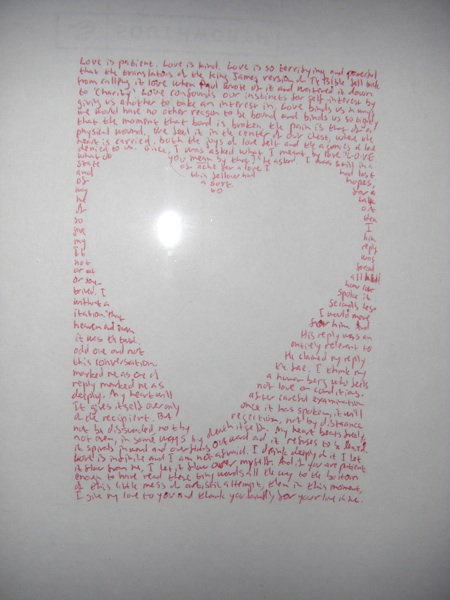
After I finished Spiral, I took a short break and then sat down and began on what became That Which Is Called the Heart.  It was an initial experiment in writing around white space and it taught me the singularly important lesson that I’ve carried to every subsequent work–use something to keep the lines straight!  I didn’t do it with this piece, and it shows.

The title, by the way, I came up with after I finished writing (I pretty much always title them at the end) and didn’t write it down on the piece itself until much later, but I realize that the title changed slightly between the mind and the pen.

That Which We Call the Heart

That Which Is Called the Heart

Most people look at it and think “Oh, pretty, a heart!  How sweet.”  Then they read the words.

Love is patient. Love is kind.

Love is so terrifying and powerful that the translators of the King James version of The Bible fell back from calling it love when Paul wrote of it and watered it down to ‘Charity.’

Love confounds our instincts for self-interest by giving us another to take an interest in.

Love binds us in ways we would have no other reason to be bound and binds us so tightly that the moment that bond is broken, the pain is that of a physical wound.

We feel it in the center of our chest, where the heart is carried, both the joys of love felt and the agonies of love denied to us.

Once, I was asked what I meant by love. “L-O-V-E, what do you mean by that?” he asked.

I was still in a state of ache for a love I had lost and this fellow had hopes, of a sort, for a way to talk me out of them.

So I gave him my reply.

It was not forced or at all faked or somehow contrived.

I spoke it without a second’s hesitation.

“That I would move heaven and earth for him.”

And it was the truth.

His reply was an odd one and not entirely relevant to this conversation.

He claimed my reply marked me as one of the fae.

I think my reply marked me as a human being who feels deeply.

My heart will not love on conditions.

It gives itself over only after careful examination of the recipient.

But once it has spoken, it will not be dissuaded, not by rejection, not by distance, not even, in some ways, by death itself.

My heart beats freely, it spirals inward and overflows outward and it refuses to be denied.

Love is infinite and I am not afraid.

I drink deeply of it.

I let it flow from me.

I let it flow over myself.

And if you are patient enough to have read these words all the way to the bottom of this little mess of artistic attempt, then in this moment, I give my love to you and thank you kindly for your love of me.

The conversation mentioned in the piece did, in fact, happen.  The fellow’s response when I provided my definition of love (“that I would move heaven and earth for him”–yes, I said it and meant it) was a slight pause and then: “You’re not human.  There’s something of the fae about you.”  The incident stuck with me in such a way that it came out of me in this artwork.  It’s not often that someone will say to you “you’re not human” and mean it as a compliment.  (Then again, this was at Dragon*Con, so perhaps not so strange in context.)

Prints of this work are available here.

The original is not for sale.